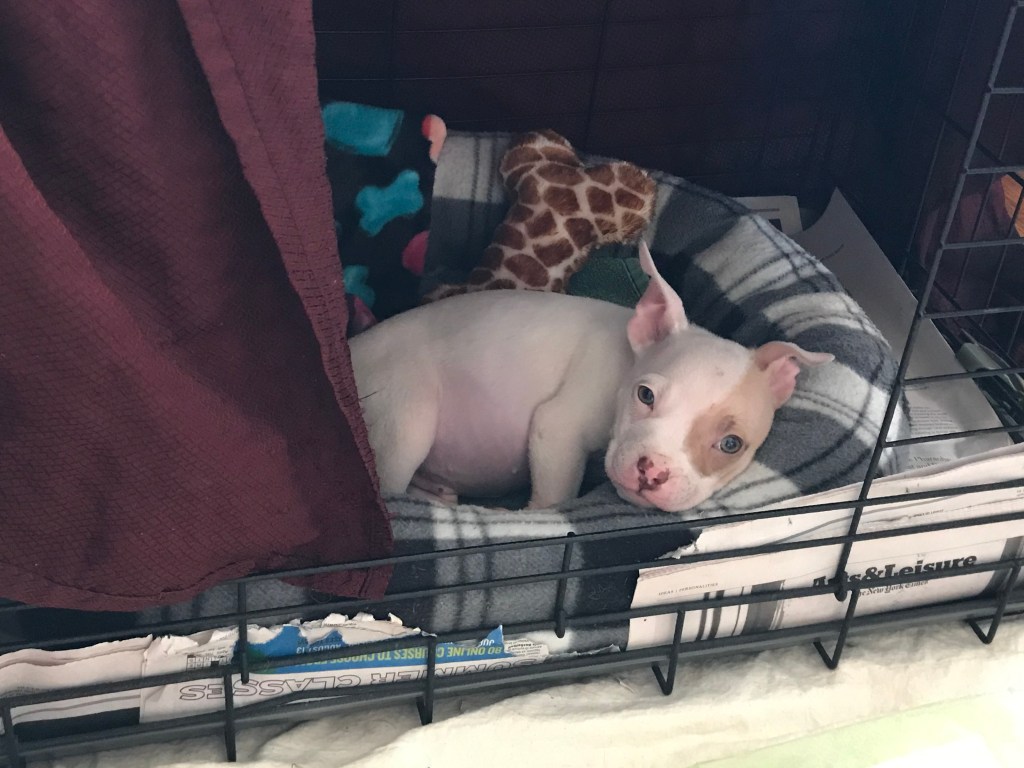
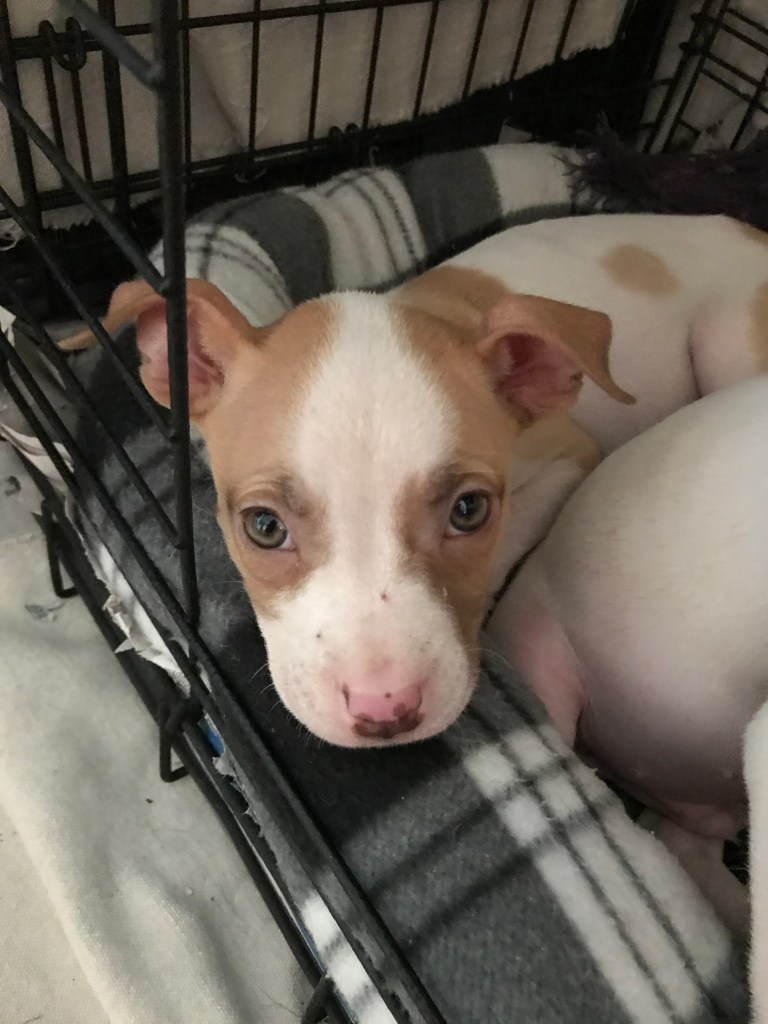
Pup v. Shrub: Who will win?

Don’t get a puppy in Winter.

A friend

With my eldest cat, Piccolo gone, after 21 epic cat-boss years, I sensed an opening for a dog. I started to mention it to some friends. “Do not,” one experienced friend advised, “get a puppy in winter. You don’t want to have to take them out in the freezing cold when they have to pee in the middle of the night.” That made sense to me. But “makes sense” and “want a puppy” don’t always match up.

So, you think you’re in charge?

I may have stacked the cards against myself by browsing on Petfinder in early Fall. There is an intro page, after you tell Petfinder your zip code, that says simply, “I want to adopt a :…” and you can click on “cat” or “dog”. Once you’ve made your choice, up pop the pictures. So what was I supposed to do – not look? Not click “dog”? Just because almost winter?

Many photos, applications and inquiries later, I adopted a 10-week-old mutt in early November, 2016. I read what I could about how to raise a healthy puppy, trying to stay just ahead of his destructive tendencies. For some reason, the how-tos don’t talk much about weather, as relates to your new buddy. Where I live, in Berkshire County, Massachusetts, we get weather. That fall and winter of 2016 were particularly snowy.

The wisdom on potty training: “Show your puppy where you want him to do his business outside, and praise him when he goes there.” And “Be consistent, so that he knows what you expect when you bring him to that area.” Under the “Teething” heading, there was “Your puppy will be looking for things to chew during his teething phase. Try to provide him with healthy chewing options to satisfy his cravings.” And also to save your shoes – that part, they leave out.

A couple of years earlier, I had planted a butterfly bush in my front yard. Each Spring, it grew new shoots from its base, which later flowered into beautiful, deep purple blooms that the butterflies loved to flit around. At its peak, the butterfly bush was over 6′ tall, and about 6′ across. A nice stopover for birds and insects, right in front of my dining area window. In winter, the old growth became dry sticks. Once young Gogo found out there was an abundant supply of sticks, anchored right there near our front steps, he was full of joy and purpose.
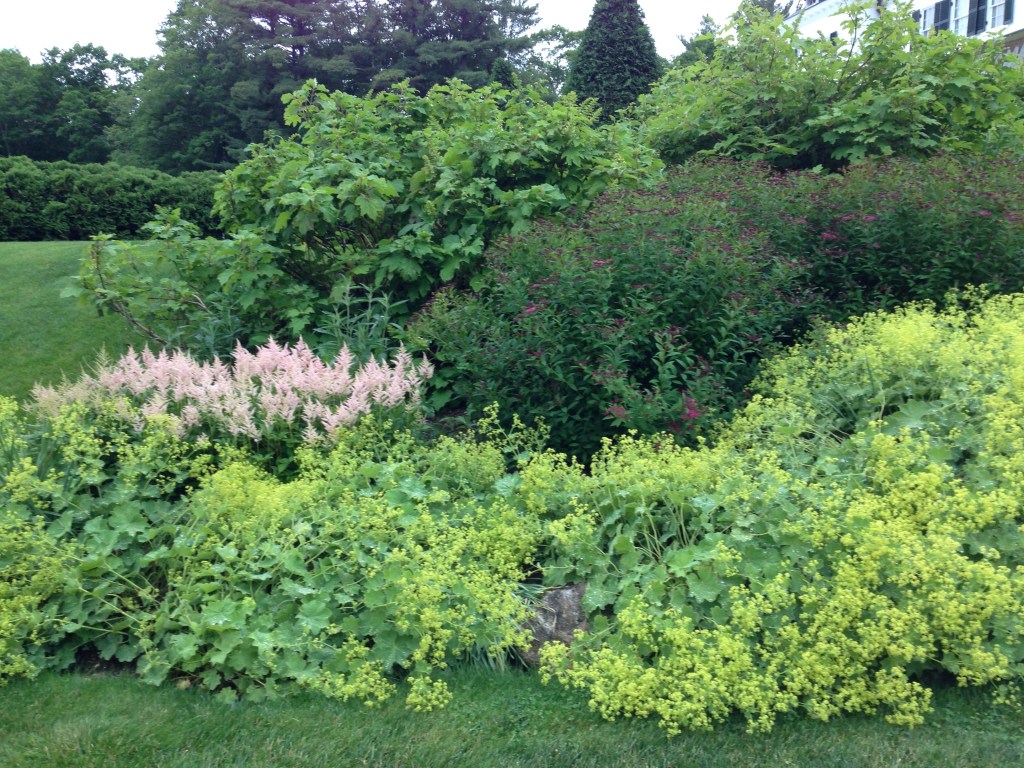
Lush summer greenery. All it needs is a little fertilizer!

That snowy season, the butterfly bush became the convenient place to pee, AND the place to harvest teething materials. Sometimes, I even harvested a stick from the bush, and brought it indoors for him. What the heck, I figured – it’s better than watching him try to taste all the furniture. And new branches will grow back in, in the Spring.

In the puppy’s first Winter, the rugs took a beating, the furniture did fine, I adapted to a disrupted sleep schedule, and the puppy thrived. By six months, he was almost fully potty trained. His teeth gleamed. Spring arrived on schedule. The butterfly bush…did not re-emerge. It remained a brown cluster of sticks. “Maybe…it’s just getting a late start,” I told myself.

I waited. I taught Gogo to pee other places. We kept harvesting sticks from the butterfly bush, though. Maybe that would wake it up? By summer, when everything else was green, I had to accept that we had killed the bush. It’s a hardy, non-native shrub in northeastern North America. Hardy, in normal conditions. But here’s a little detail you won’t find in Wikipedia: How much urine does it take to kill a butterfly bush? About one large puppy-winter’s worth.
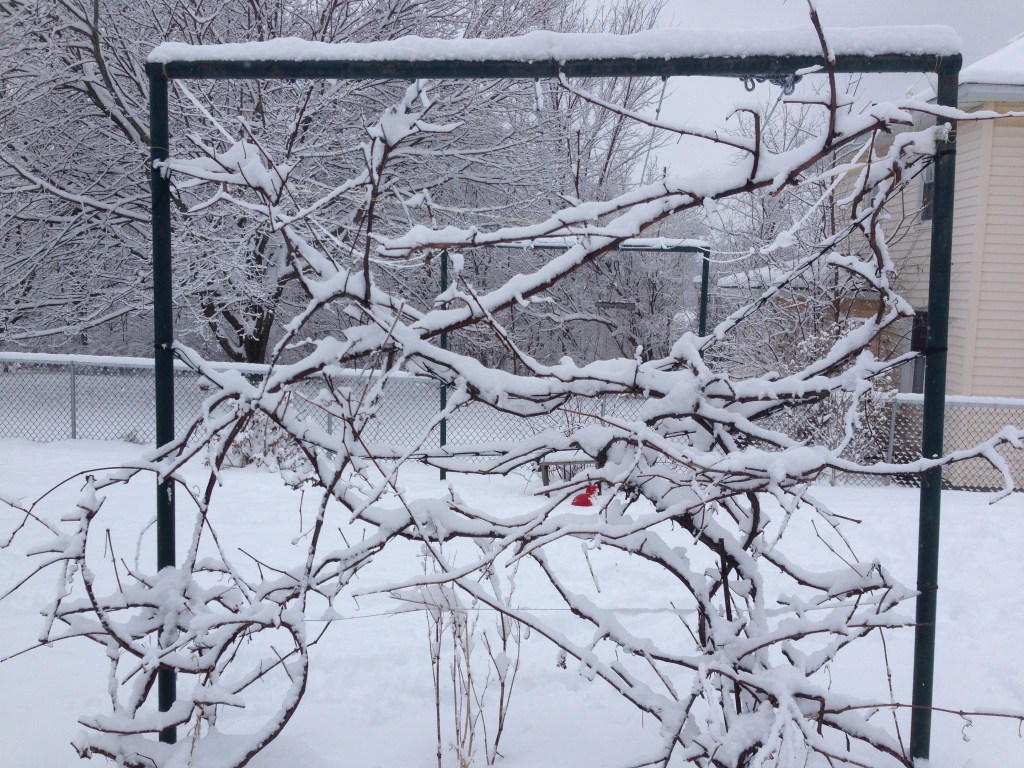
Winter garden scene in the Berkshires. Dormant grape vines.

Another fun fertilizer fact, for you lawn-and-garden fans out there: pee is full of nitrogen. In limited amounts, grass and other plants LOVE nitrogen. I’ve noticed this during summer months, when trying to put off mowing as long as possible. Most of the lawn stays at an even length after mowing. Then the dandelions, out of spite, will extend a full 2 inches taller than their surroundings, within a day or two. Normal.

Once a week goes by, though, it’s very noticeable that surrounding every Favored Pee Spot grows a ring of lush grass, an inch or three taller than everything around it. In the center of the Favored Pee Spot is a low, dead, brown bullseye. That’s what gives it away as a Favored Pee spot (by this time, Gogo is allowed to go out and pee on his own, so I don’t always witness where he goes).

My understanding, from experience and anecdotal stories from friends, is that girl dog pee is more damaging to lawns than boy dog pee. Boy dogs like to share their bounty, and mark as much territory as is caninely possible. So their ammonia-laden potion gets spread around. Girl dogs just squat ‘n’ go, not trying to prove anything other than how good it feels to have an empty bladder.

Around here, the grass is forgiving, the rain tends to be plentiful, and the lawn always rebounds — even the bullseyes. If I get to do it all over again with another puppy, male or female, I’ll teach the little critter to pee on my open-air compost pile, and really put that extra nitrogen to good use. They can pee on the shrubs, too. Just not always the same one.

The Acoustics of Dog Care

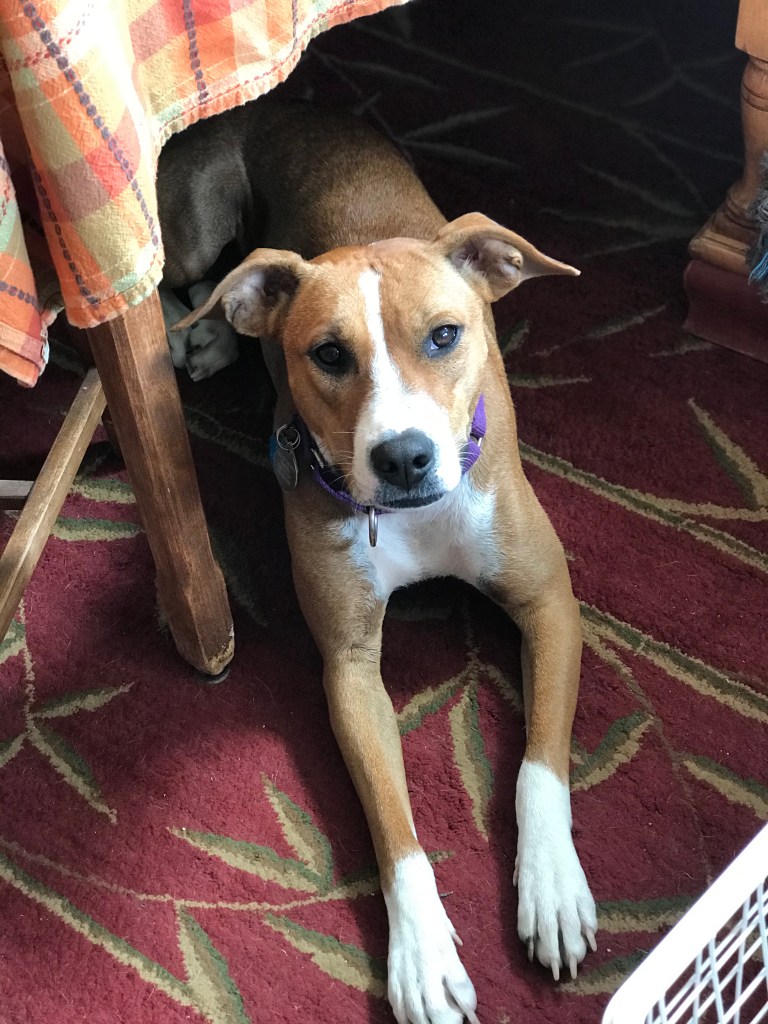
Octavia quietly waits for something good to fall under the table.

Beware the sounds of silence

Caring for dogs or puppies in your home is a sensory-intensive experience. There is fur or hair, soft or bristly to touch. The moist sensation of being licked — out of nervousness, or love, or who-knows-why, just get ready, tongue ‘n’ snoot comin’ atcha. The scents, of varying intensity – no explanation needed there. Then there are the sounds.

The clicks, growls and purrs of puppies, dogs and one cat are what make my house sing, without me having to orchestrate. Sometimes I try to capture the best sounds: months ago I pushed “Record” on my smart phone, standing in my basement, while the mini-stampede of two puppy siblings chasing after the same toy thundered along the hardwood floor in the bedroom directly above. The recording only captured whatever was quietly humming in my basement at that time. But I sure enjoyed the heck out of the live percussion concert, above.

I’ve tried to record Gogo, my very good boy, doing his signature falsetto mini-howls in his sleep. Sometimes it escalates into a full-throated, mature and mournful howl. How he does that without waking himself up, I’ll never know. But he’s been doing it for as long as I’ve known him. I’ll never get tired of it. Alas, I’ll never get a good recording of it, either; I’m just not that quick with the function buttons on my phone. My active listening takes over, and my fingers fail.

You get used to the sounds of the critters chewing, drinking, scratching their favorite things. Gogo drinking from his water bowl (a one-gallon Pyrex bowl; I needed something too heavy for him to knock over when he was a puppy — don’t judge us) sounds a bit like what you’d expect to hear when a bison bellies up to the watering hole. Maybe without the snorting. When Octavia, the new recruit, drinks from the same bowl, it sounds like a gently trickling stream. Either way, I can tell from two rooms away that my animals are hydrating themselves. And that’s good.

Then there are the sounds of the critters chewing, drinking and scratching my favorite things. And that’s usually not good. Here are some of the sounds I’ve learned, some in time to intervene:

A bamboo and cotton item, previously known as a coaster, being pulverized;

The soft squish-‘n’-squeak of my leather clog as it is being taste-tested by a medium-sized dog;

The thud of a 12.5-oz metal cat food can hitting the rug after being dropped from dog-mouth height, 20′ away from its usual storage shelf; followed by gentle rolling sounds;

The r-r-rip of a guest-dog’s plush squeak toy being eviscerated by the host dog who, for good reason, is not given plush toys any more;

The light, quick steps of the guest dog sneaking into the host dog’s crate to have a snooze while no one is looking;

And the most dangerous sound of all when you’re home with all your animals: silence.

It’s easy not to notice silence, at first. One might be busy, say, writing a blog post, and not realize that there are no bone-gnawing, cardboard-clawing or other wholesome activities going on. And heck, they might be sleeping.

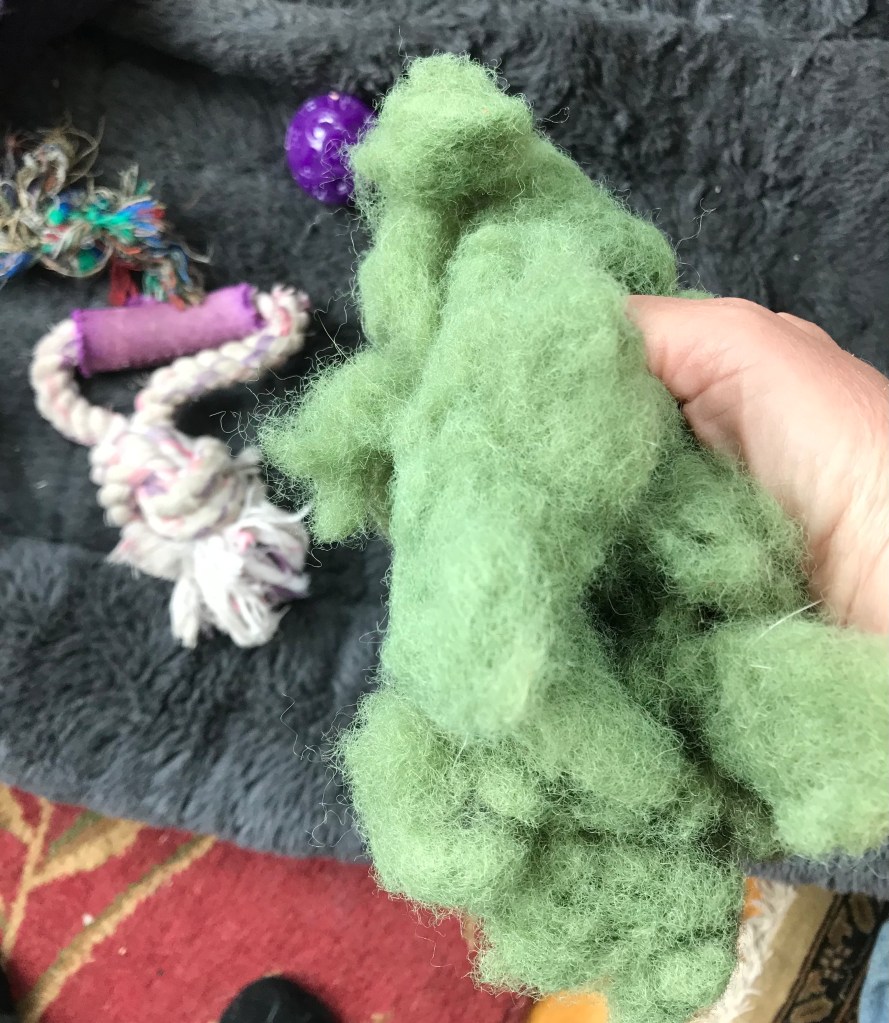
The stuffing material formerly known as part of Octavia’s new bed. Quietly extracted.

But then you go and poke your head into the silent bedroom where two 8-week-old puppies were napping, last time you checked. And see: nothing. And hear: nothing. Or, one is running up and down the floor along the edge of the bed, yapping, and the other one is…not there. Not making a peep.

In the case of Remo and Ruthie, my recent dynamic duo, that meant that once again, one of them* had figured out a way past all the baffles and barricades I put up to block them from going under the guest bed. Did you know, when you’re six inches tall, and weigh less than ten pounds, what the underside of a full-size bed looks like? The most awesome playground you’ve ever seen. And do you now what puppies like to do in their awesome playgrounds? Poop. And pee. Every chance they get. Every. Chance. Oh, and for reference: those extra boxes and other smooth surfaces you shoved under there to keep the varmints out? They make great pooping surfaces, too. And their sound-dampening properties just can’t be beat.

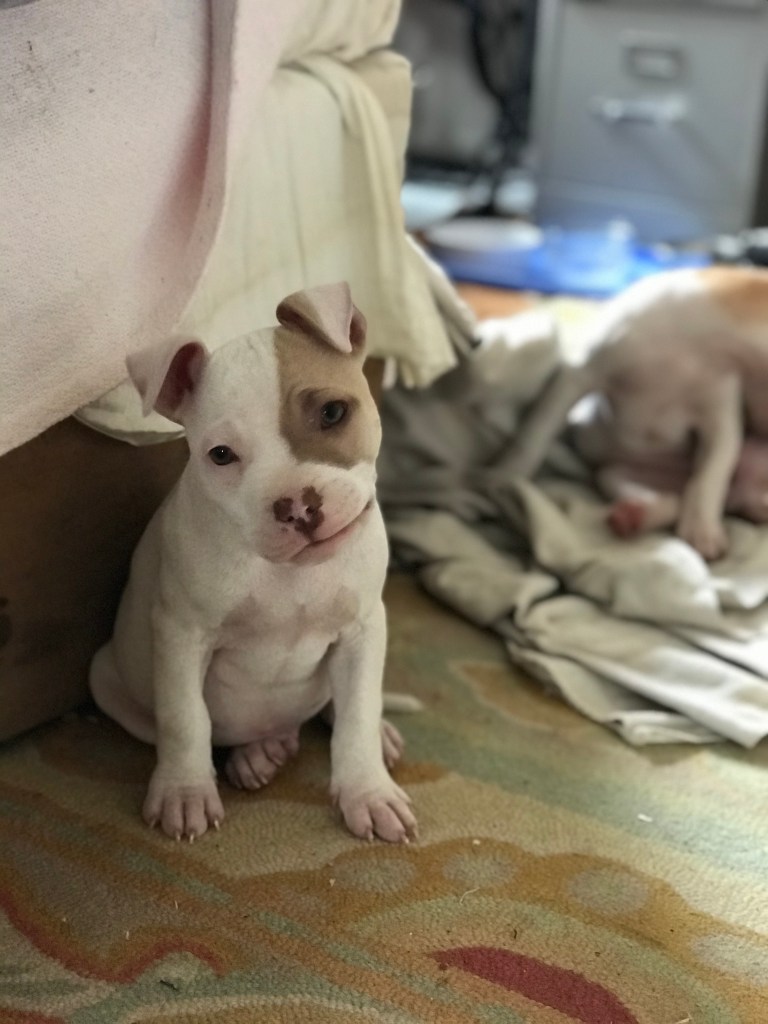
Remo at the foot of the bed…waiting for me to look away.

On the bright side, active silence is how you know that they know they’re not supposed to do that. So you have some good behavioral material to work with. They have been listening, up to a point. The elaborate positive-reinforcement parties I threw for Remo and Ruthie every time they pooped someplace good were pretty impressive, if I may say so. They helped. I…think.

Remo and Ruthie moved out before they’d convincingly learned not to poop under the bed. By then I’d also invested a roll of duck tape, three pieces of scrap plywood, several wood screws (to screw the boards directly into the box spring frame), some para-cord, two pieces of metal crate dividers, and a heavy dose of my time and dignity, to block temptation. They have now each been adopted by loving families.

As I write this conclusion, I can hear Octavia chewing a delicious bone nearby, and Gogo snoring away in his bed. Oh, wait — I just heard the flap-flap-flap of ears-on-noggin. Gogo’s awake. His belly must know it’s 5:05 pm. Time for supper!

*Remo, I know it was you, you little bugger. I forgive you.

Pumpkin on my elbow makes me happy

How to Make Puppy Poop Taste Bad

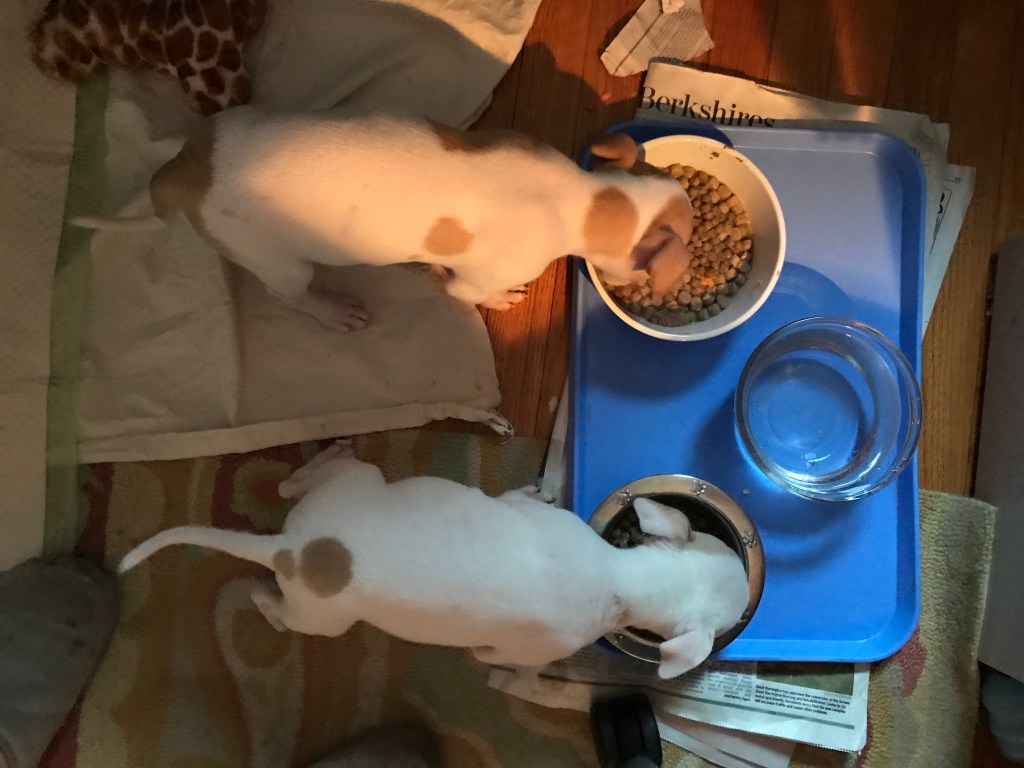
Ruthie (left) and Remo after 16 days in foster, 3 to 4 meals per day.

Wait – doesn’t puppy poop already taste terrible? You’d think so. But here’s an alternate take:

Let’s say that you’re a puppy and your only source of food, for your first twelve weeks, is your mom’s milk. Now, realize that your 5 siblings are in the same situation. And your mom is underweight, and underfed. You’d probably be very interested in eating anything you can find. If all there is, is poop, then poop is what you eat. With gusto.

This is the setting that Remo and Ruthie were born into. Hungry, covered in fleas, living outdoors in somebody’s yard for a minute, til their first humans at least had the decency to surrender them to their local animal shelter in an upstate New York town.

A normal healthy puppy gets milk from their normal healthy mom for the first 6 to 8 weeks of life. Then they get solid food, meant for puppies, with extra protein, fat and calories to help them grow. But that’s not how it went down for Remo and Ruthie.

So having formed the habit of competing for any poop pile they can find, they were not going to give that habit up easily.

“Well, once they’ve eaten a real meal, and they’re full, surely…” I thought.

“Once they realize that they are getting regular meals, three or four times a day, they wouldn’t… would they?”

Waiting for them to see the light, stuffing their guts with great food did nothing to change their behavior. I was picking up their poop as soon as I sensed it had hit the floor. I started to rack my brain about how to get the poop-eating to stop. Had I read something somewhere about adding hot pepper to the poop, and let them eat it? Wait – was that for some other animal? Is hot pepper toxic for puppies? Augh!

I turned to our foster group leader. “I’m having this problem…” I said to her as I was picking up the de-worming medicine from her. I explained that the puppies aggressively compete to own each poop, no matter who deals it.

“That’s because they’re still used to being starving,” she said. “Try putting some pumpkin puree in their food. Just plain, from a can. Either that, or try some pineapple. Just a small spoonful, mix it in. It tastes good going in, but it makes their poop taste terrible when it comes out. That should do the trick.”

That night, I put some pumpkin in their dinner. It was a BIG hit. At one point, Remo was hogging all the food, and growling at Ruthie for trying to get her share. He was eating maniacally. I picked him up to force him to take a break. There he was with bright orange pumpkin smudges all over his chin. He looked up at me, blinking, and let out a big burp. “NOW you feel better,” I told him. He squirmed as I put him back down, and ended up smearing what was left of his pumpkin-chin on my shirt sleeve. A nice long mushy stripe up to my elbow. I sighed. ‘This kid’s going to go far,’ I thought. ‘With that kind of charm…’

Late the following day, I noticed that they weren’t devouring the poop; just tasting it, then leaving it. I still tried to be quick at picking it up off the floor. Because, yuck. By the time we got through 2 full cans of pumpkin (several days of meals), only Ruthie was still trying to eat poop. And less enthusiastically, at that.

When I ran out of pumpkin, we switched to crushed pineapple. I had never known that pineapple was ok for dogs to eat. I would have thought it too acidic, like citrus. They hate citrus. The first trial with pineapple went slowly. It was mixed into their food, and it took them almost twice as long as usual to eat it. ‘Well forget that, ‘ I thought. ‘I need them to eat.’ I thought pineapple was a fail. But then I decided to try again, and just give it to them straight, as dessert. That worked! They gobbled it up. And boy, the next day’s poop was noticeably stinkier. And they didn’t eat it. Not any of it. Ta-daa!

Parasites suck

Problematic parasites appear in puppy poop.

Disclaimer: I am not a forensic expert, diagnostician, veterinarian, or professional dog trainer. I am a relative rookie with dogs, learning as I go. Fostering puppies is an eye-opening experience. There have been lots of times I have thought, “Jeez, I wish I’d known THAT before.” Sometimes all I learn is whatever I can Google-search while the little varmints are napping. Those naps are just not long enough.

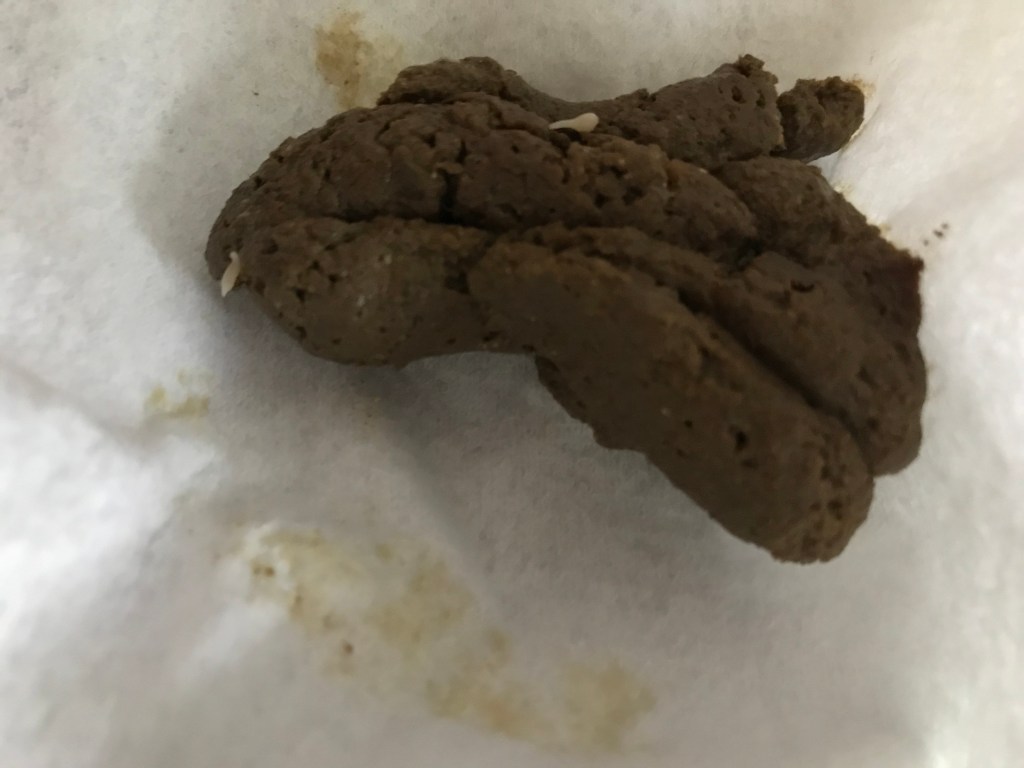
Second disclaimer: if you don’t like looking at worms or poop, don’t look at the photo that’s at the end of this entry.

Here is what I have learned this week about cute little puppy bellies. There is the wholesome round variety, which, in addition to being adorable, is healthy. Just like human babies, as puppies roll and romp, they develop the abdominal muscles that eventually pull their rib cages down and inward, so the ribs no longer flare out, and their torsos become streamlined.

Then there is the distended puppy belly, which is not healthy. News to me: the distended variety is likely a sign of a parasitic worm infestation. In the case of Remo, my latest male foster pup, the distended belly was his only sign. Then, I noticed all the wiggly worms scattered in his poop. OK, that’s a pretty strong sign.

I wasn’t looking for the worms, because I thought the distention was just a side effect of his newborn malnutrition. I didn’t even know, at first, which of the two siblings was pooping out worms. With two 13-week-old puppies in one room, there’s a lot going on.

Remo (top) and Ruthie on 3/21/21. His belly is distended. He is growing, though.

Like all puppies who come through the dog rescue group I volunteer with, this duo received de-worming treatment as soon as they were taken in from their original unsafe environment. At that time, they tested negative for worms. On their 8th day in my home, I noticed small, off-white wriggly things in a poop pile I picked up from a pee pad. And these wriggly things were lively. Not at all acting as if they’d been poisoned; more like they were trying to escape the pile. “Sshit,” was my reaction. I reported the problem to the dog rescue group. The rest of the litter probably had worms, too, if these guys did.

I double-bagged the offending stool sample, in case a vet run was needed. Veterinarians are the ones who can examine a fecal sample, figure out what the offending organism is, and make a treatment plan. With one sample, a plan can be made for all six puppies, and possibly the mom, if needed.

For the next few days, I saw no worms, no problems. ‘Are they messing with me?’ crossed my mind. Then last night, and this morning — four days after the first sighting — a whole bunch of the little parasites appeared in Remo’s deposit. This group was not as lively as the first. Many of them were clearly dead. But still — ewww.

My educated guess is that these are tapeworm segments. The worm type does matter, in determining which medicine is needed to kill the worms and get them to not come back. But as far as the pups are concerned, there are no good worms. They are all parasites.

Remo (bottom in this pic) and Ruthie,March 27, 2021. Remo is catching up to Ruthie in growth, but his belly is still distended.

They all have to go. Otherwise, the little guy is chronically deprived of nutrients. And he can get sick. And — here is a part that is brand new to me — I can get sick, too, if I accidentally ingest any segment or egg. Eventual consequences of contaminating myself can include blindness. I learned that today! So my choices are easy, but the results are time-consuming. I must:

  • Pick up every puppy poop ASAP, so they don’t eat it, or walk in it, then lick their toes;
  • Examine said poop, for signs of worms;
  • Wash my hands well, every time I go near the poop;
  • Go get the vermicidal medicine recommended; administer to both pups as directed;
  • Keep the puppies confined to their room so nothing spreads to anyone else.

I’m waiting now for a message telling me when and where to pick up medicine for these two problem tenants of mine. This mini pack of double trouble are as much a part of my education today, as I am of theirs. I hope to defeat the parasites. We’ll all feel better.

IF SQUEAMISH DO NOT EXAMINE PHOTO BELOW.

The offending parasites. Very active; these bastards are trying to flee! Possibly tape worm segments.
<p value="<amp-fit-text layout="fixed-height" min-font-size="6" max-font-size="72" height="80">

Puppies are Jerks

AND OTHER TRUTHS

My two new foster pups are brother and sister: Remo and Ruthie. “Remo” is not a typo of Romeo; it’s a brand of drum equipment, and I know all you drummers out there knew what I meant. Aptly, Remo has a perfectly round, white belly that gets visibly bigger the SECOND he starts eating a meal. I haven’t verified that the acoustics of his belly change as he fills up. But let’s assume they do.

Ruthie is named for Ruth Bader Ginsberg. Like the Notorious RBG, Ruthie is petite, and in charge. She was the first one of the two to demonstrate that yes, we do know how to bark; we were just working our way up to it. Now she barks every time she sees injustice – like when Remo is hogging her favorite bowl.

Remo. With hoarded toy behind him.

Considering they had no manners at all when they arrived only a week ago, Ruthie and Remo are doing very well in the civilization department. But they are still terrible. They are my 7th and 8th foster pups, but I have set an all-time record for loads of laundry run on their behalf – they surpassed the competition by day 3.

They have gone from pooping up the crate 5 out of 5 times, to pooping it up rarely. At first they slept 3 hours at a time overnight; now they can go 6. Flat newspapers on the floor have transformed from “Hey! check out the aerodynamics on THIS toy!” to “This is where we poop and pee.” At least, more than half the time….

Ruthie. Fending off…a…nap.

These two varmints are from a litter of six very undernourished puppies, being raised by a dangerously underweight mom who just had nothing left to give them. The humans in charge of them did not think to give them any food. Well, that may be inaccurate; hard to know if they thought, or not. All I know is these two, and their 4 littermates, had all ribs showing, thin fur, scratches, fleas, distended bellies, and desperate appetites. And my job is to help them forget all that. Here goes.