Gogo will now share the correct answers to the Supreme Court Justice Interview Questionnaire we posted. Clearly, the correct answers were not evident to all humans in recent years; but in 2022, things are looking up. A score of 100% is recommended in order to be nominated to the Court.
Answer to Question 1: YES. You are kind to animals. So far, your potential as a Supreme Court Justice is limitless. Proceed to question 2.
Answer to Question 2: c) a and b. You would choose to snuggle with a dog and a cat if there were a warm fireplace and a big comfy chair. You could also choose individual options, such as a) a dog, since you may not have had the benefit of cat-snuggle experience yet. Or if you wrote in the margins, “We’re gonna need a bigger ottoman”, that would be acceptable. Speaking as someone who has bony elbows and tends to spill over boundaries and things, I get it. Also there’s the “I’ll need to get up and refill my teacup” option, making above ottoman reference an excellent choice, and the sign of an experienced planner.
Answer to Question 3: d) a, b and c. For a colleague who is being a total jerk face — we’re not just talking nips your tail when you’re sleeping, or hogs all the cushions — we’re talking won’t keep his slobber to himself, never takes his turn to fill the water bowls, and acts like he doesn’t know where all the chow went even though everybody knows he ate it. With such a character, even though we can’t throw him out of the pack, it would be sound judgement to a)Let me bite him on the ankles a little; b)Explain that sometimes we have to do things that are hard so everyone can be ok; and c)Put him on your list of Worst Jerkfaces of All Time, DO NOT GIVE TREATS.
And finally,
Answer to Question 4:d)All of the above. Alas, when there is a really big, loud human who says he needs your help because the Squirrel Mafia came and took all his legumes and hid them, simply telling him to go away, as in choice a), has been proven to be ineffective. Some would say it only encourages the noisy fluffer.
One can try telling the loud human there is no Squirrel Mafia, as in choice b). It’s worth a try. But you may be met with protestations that you have spent too much time with your Fake Optometrist, who has equipped you with Squirrel-blocker glasses so you just can’t see the Squirrel Mafia, and that’s your fault. More tools are needed.
In option c), we ask the loudmouth if he really, but really, had a lot of legumes, or if he just WISHES he had. Again, worth a try. Gives the subject a chance at self-reflection. But this is like waiting for cats to admit they’re not as strong as dogs. Truth hurts. Admission may never come. A combo approach may be our only hope. OR, we can resort to the ankle-nibbling option from Question 3.
Disclaimer: Gogo does not condone violence. Self-defense is important, though. A growl should always be tried before a bite.
a) Pit bull puppies can cost $2,000 to over $20,000.
b) Pit bull dogs are killed at a higher rate than any other dog breed in the US.
c) All of the above.
The answer is c). For many years, pit bulls have had a reputation as strong, fierce, loyal dogs. They have been popular as pets; then unpopular; then publicized as dangerous dog-fight dogs; then popular again.
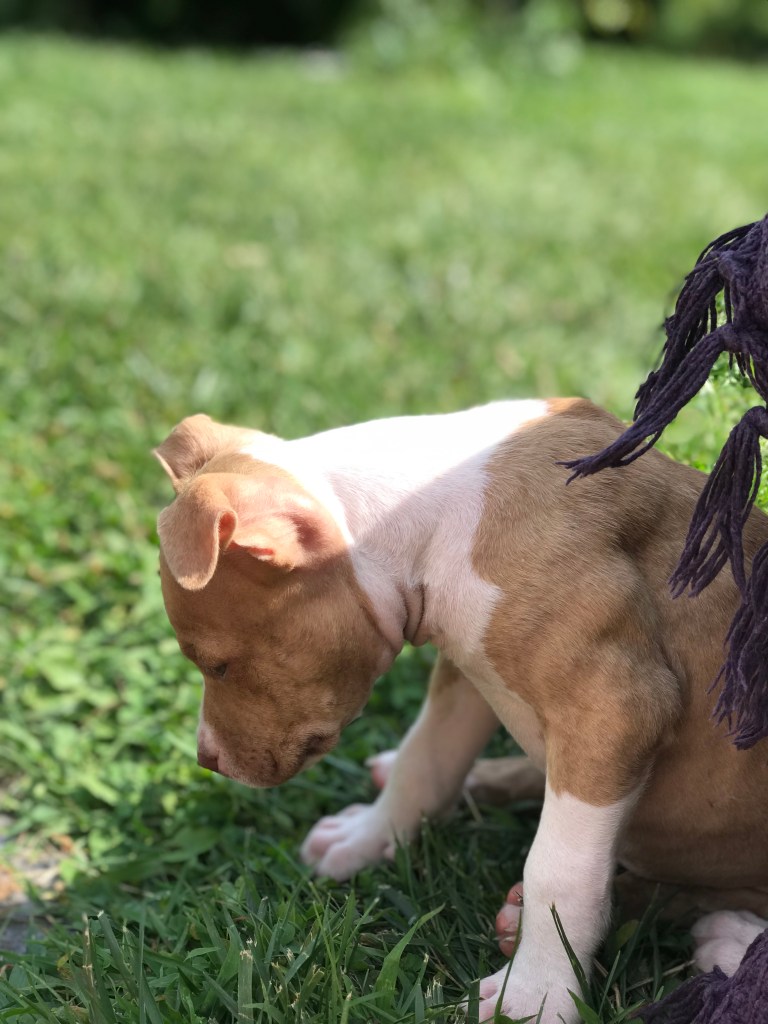
Deep in thought. Pit bull pup.
Periodically, the pit bull image has a setback. In the late 1980’s, Anheuser-Busch used a bull terrier they named Spuds MacKenzie to sell their light beer. They dressed him in cute shirts, surrounded him with tall, fawning human babes and called him the “ultimate party animal”.
The New York Times reported that between 1987 and 1988, ads featuring the dog helped increase light beer sales by 20%. When that ad line was discontinued, in 1989, it was rumored that it was because the dog was a pit bull, and pit bulls had lately come to be seen as mean and vicious. The official reason given by the company, according to Wikipedia, was that “the character’s image had started to overshadow the product.”
To many, pit bulls are a status symbol. Can anyone explain status symbols? I can’t, any more than I can tell you why anyone would want a Cabbage Patch doll (expensive ugly!), or a pair of Jimmy Choo stilettos (expensive pain!). Sometimes, when a thing is something you think you can’t have, you want it more. Sometimes, when you finally do get it, you want everyone to know you got it.
To some, having a pit bull by their side is a symbol of strength. If I can control this beast, I must be strong, right? For some, having a pit bull in the house is security against intruders. Sometimes the detail about teaching the dog the meaning of “intruder” escapes the buyer.
I recently watched an old episode of a trainer-solves-dog-problem TV show. The family had bought a pit bull puppy for their grandmother, who had no experience with dogs. A year later, the dog was barking at everything and everyone, and the family couldn’t have anyone over to the house without locking up the dog to prevent it from lunging at the visitor. So the trainer got to work, teaching the dog that not all non-family humans who visit are bad.
On camera, at least, no one sits the family down and says, “You got your grandmother a puppy, with no plans to train it?! WTF were you thinking?! And who sold you this dog?!” After intensive training, the TV trainer has gotten the dog to accept close family friends into the house without incident. Lawsuits, bloodshed averted in this case.
There are companies based in the US that have turned pit bull breeding into big business. If you’ve got the cash, you can have a super-sized pit bull flown to you, anywhere in the world. According to one dog-shipping company’s website, the dog or puppy can be brought right to your door, escorted by a trainer to get you started. Presumably, if you have tens of thousands of dollars to spend on a luxury dog, you can follow that up with a few thousand more to teach the dog that you are their family, among other skills.
In the metro Atlanta area, there is a dog kennel that breeds a few varieties of dog with “bull” in the name — including French bull dogs, and pit bulls. The niche this company has made for itself, to establish its brand, is that its pit bulls are bred to have short legs. Is there an advantage for a highly muscular and energetic dog to have short legs? Certainly not for the dog. How would it help a dog, to need to take twice as many steps to get anywhere? What is the advantage of building a locomotive body, and then putting it on tricycle wheels? Brand recognition, is the only answer I can come up with.
The sole purpose of this adaptation is to make the dog recognizable as a product of PitFall Kennels. PitFall Kennels is run by James Patton, brother of the musician who goes by the name Big Boi. Selling dogs with short legs is what sets their kennel apart. I did not do any sleuthing to find this out – I heard Big Boi himself describe his dogs, and how he got into the dog breeding business, while he was appearing on NPR’s radio news quiz show, “Wait, Wait…Don’t Tell Me!” It’s easy to find video clips of the brothers, and the kennel, on YouTube and elsewhere on the internet.
To its credit, there is information on line that PitFalls Kennels also does rescue work for dogs. Specifics on that aspect of the business are not as easy to find.
Evidence is everywhere that there are already far too many unwanted pit bulls in this country. Dog shelters post pleas for help on social media, often with specific expiration dates under dog photos. The “rescue by” date is the day on which the dog is scheduled to be euthanized.
A quick search on Petfinder.com today lists 3,100 available dogs (in shelters or foster homes) within a 100-mile radius of my zip code in Western Massachusetts. Of these, 475 are listed as pit bull terrier.
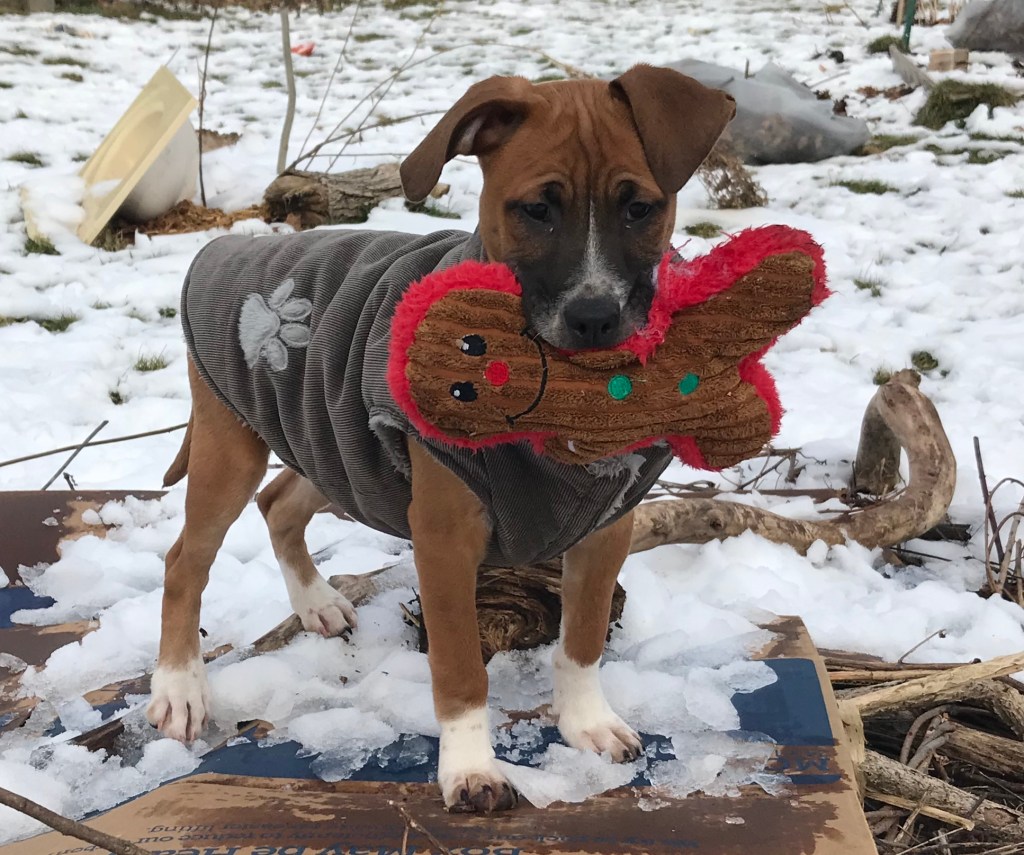
This well-dressed mystery mutt is part pit bull terrier.
Typically, if a dog is of mixed breed, such as Labrador retriever mixed with pit, pit bull terrier becomes the secondary breed listed in the dog’s description. Or ‘pit’ may not even be mentioned if unknown. Therefore, a search for “pit bull” does not yield listed mutts. So, while only 15% of these Petfinder-available dogs are listed as pit bull terrier, the percentage of pit-mix dogs is certain to be much higher.
Petfinder (http://Petfinder.com) is a leading resource for anyone looking for a pet to adopt. But some animals, due to poor health, or poor socialization, are not deemed to be adoptable, and don’t make it onto Petfinder’s site. Some animals don’t last a week in a crowded shelter, before they are euthanized, to make space for another animal that has better adoption potential. Many of the dogs euthanized, or put on death row, are pit bulls.
Training a puppy from scratch takes a ton of time and work. Training any dog that has been abused, trained to fight, starved or neglected takes time, patience and resources that sometimes are just not available. Even a dog that has been fed and taken to the vet, but not trained to be a good citizen, is a challenge. Every dog needs to be taught who the Good Guys are. If they are left to guess, they may end up defending against a hapless passer-by.
According to Save-a-Bull rescue (http://saveabullmn.org), studies estimate that up to one million pits are euthanized per year, or 2,800 per day.
Right now, status symbol dogs aside, the supply of pit bull-type dogs far exceeds demand. Conditions in the US do not support an increase in demand. Would it be too much to ask for a decrease in supply?
Octavia quietly waits for something good to fall under the table.
Beware the sounds of silence
Caring for dogs or puppies in your home is a sensory-intensive experience. There is fur or hair, soft or bristly to touch. The moist sensation of being licked — out of nervousness, or love, or who-knows-why, just get ready, tongue ‘n’ snoot comin’ atcha. The scents, of varying intensity – no explanation needed there. Then there are the sounds.
The clicks, growls and purrs of puppies, dogs and one cat are what make my house sing, without me having to orchestrate. Sometimes I try to capture the best sounds: months ago I pushed “Record” on my smart phone, standing in my basement, while the mini-stampede of two puppy siblings chasing after the same toy thundered along the hardwood floor in the bedroom directly above. The recording only captured whatever was quietly humming in my basement at that time. But I sure enjoyed the heck out of the live percussion concert, above.
I’ve tried to record Gogo, my very good boy, doing his signature falsetto mini-howls in his sleep. Sometimes it escalates into a full-throated, mature and mournful howl. How he does that without waking himself up, I’ll never know. But he’s been doing it for as long as I’ve known him. I’ll never get tired of it. Alas, I’ll never get a good recording of it, either; I’m just not that quick with the function buttons on my phone. My active listening takes over, and my fingers fail.
You get used to the sounds of the critters chewing, drinking, scratching their favorite things. Gogo drinking from his water bowl (a one-gallon Pyrex bowl; I needed something too heavy for him to knock over when he was a puppy — don’t judge us) sounds a bit like what you’d expect to hear when a bison bellies up to the watering hole. Maybe without the snorting. When Octavia, the new recruit, drinks from the same bowl, it sounds like a gently trickling stream. Either way, I can tell from two rooms away that my animals are hydrating themselves. And that’s good.
Then there are the sounds of the critters chewing, drinking and scratching my favorite things. And that’s usually not good. Here are some of the sounds I’ve learned, some in time to intervene:
A bamboo and cotton item, previously known as a coaster, being pulverized;
The soft squish-‘n’-squeak of my leather clog as it is being taste-tested by a medium-sized dog;
The thud of a 12.5-oz metal cat food can hitting the rug after being dropped from dog-mouth height, 20′ away from its usual storage shelf; followed by gentle rolling sounds;
The r-r-rip of a guest-dog’s plush squeak toy being eviscerated by the host dog who, for good reason, is not given plush toys any more;
The light, quick steps of the guest dog sneaking into the host dog’s crate to have a snooze while no one is looking;
And the most dangerous sound of all when you’re home with all your animals: silence.
It’s easy not to notice silence, at first. One might be busy, say, writing a blog post, and not realize that there are no bone-gnawing, cardboard-clawing or other wholesome activities going on. And heck, they might be sleeping.
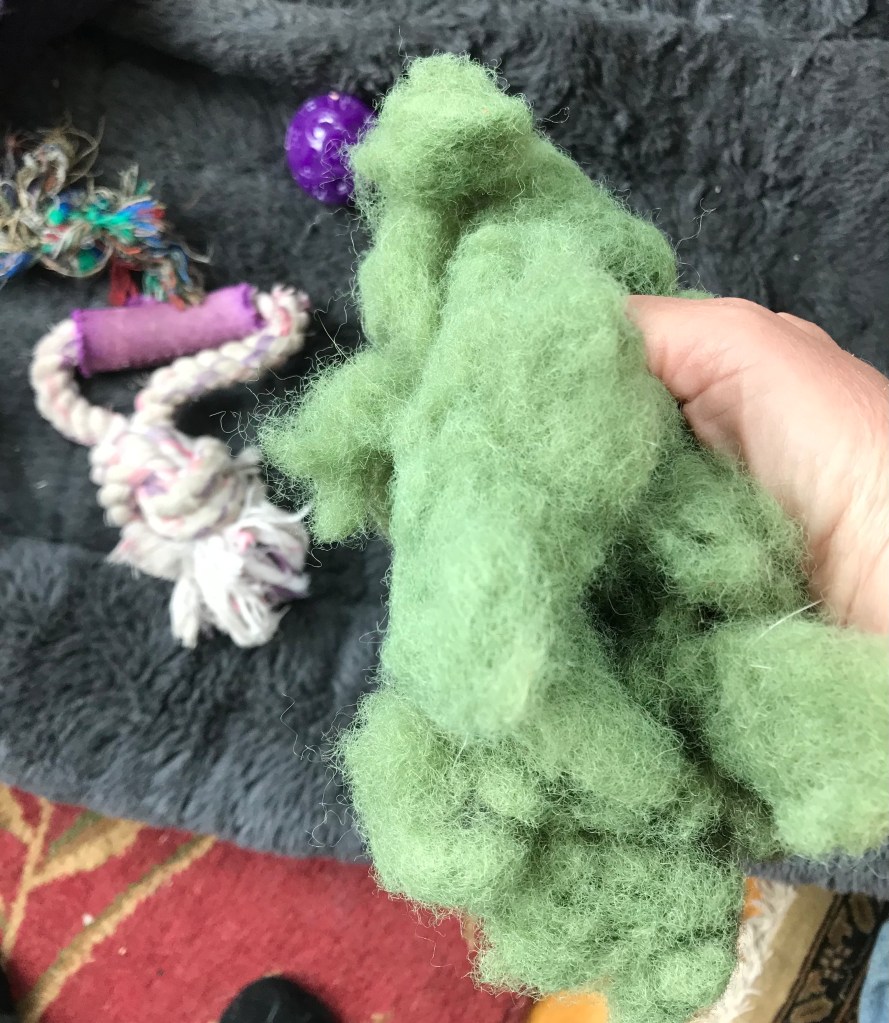
The stuffing material formerly known as part of Octavia’s new bed. Quietly extracted.
But then you go and poke your head into the silent bedroom where two 8-week-old puppies were napping, last time you checked. And see: nothing. And hear: nothing. Or, one is running up and down the floor along the edge of the bed, yapping, and the other one is…not there. Not making a peep.
In the case of Remo and Ruthie, my recent dynamic duo, that meant that once again, one of them* had figured out a way past all the baffles and barricades I put up to block them from going under the guest bed. Did you know, when you’re six inches tall, and weigh less than ten pounds, what the underside of a full-size bed looks like? The most awesome playground you’ve ever seen. And do you now what puppies like to do in their awesome playgrounds? Poop. And pee. Every chance they get. Every. Chance. Oh, and for reference: those extra boxes and other smooth surfaces you shoved under there to keep the varmints out? They make great pooping surfaces, too. And their sound-dampening properties just can’t be beat.
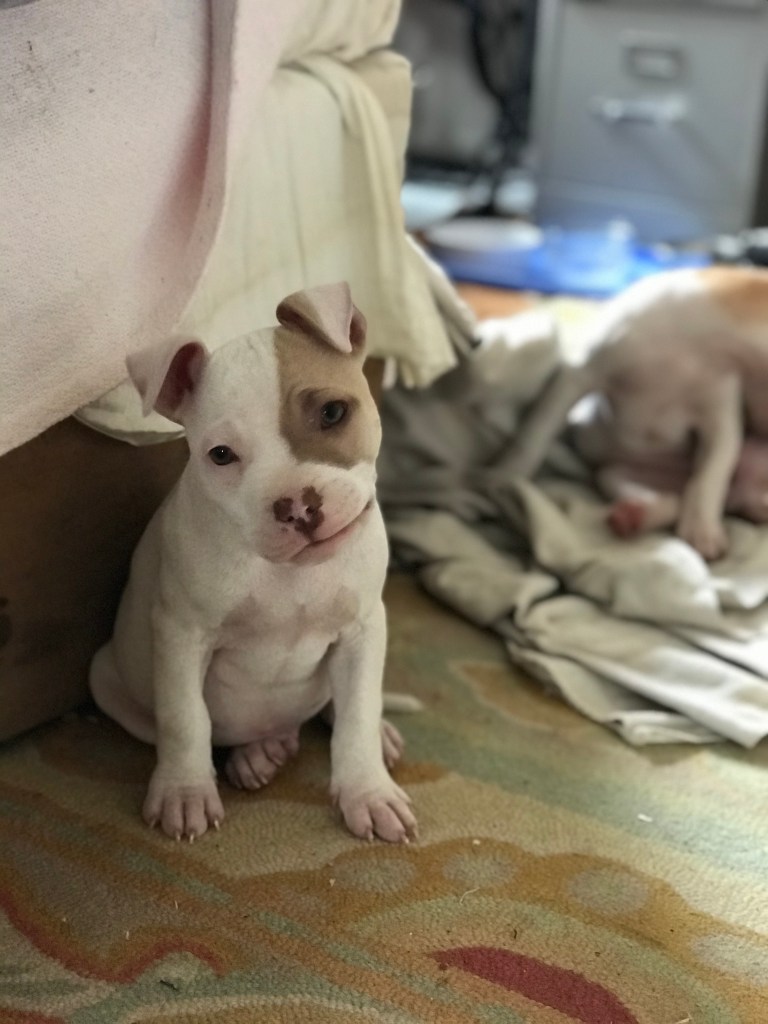
Remo at the foot of the bed…waiting for me to look away.
On the bright side, active silence is how you know that they know they’re not supposed to do that. So you have some good behavioral material to work with. They have been listening, up to a point. The elaborate positive-reinforcement parties I threw for Remo and Ruthie every time they pooped someplace good were pretty impressive, if I may say so. They helped. I…think.
Remo and Ruthie moved out before they’d convincingly learned not to poop under the bed. By then I’d also invested a roll of duck tape, three pieces of scrap plywood, several wood screws (to screw the boards directly into the box spring frame), some para-cord, two pieces of metal crate dividers, and a heavy dose of my time and dignity, to block temptation. They have now each been adopted by loving families.
As I write this conclusion, I can hear Octavia chewing a delicious bone nearby, and Gogo snoring away in his bed. Oh, wait — I just heard the flap-flap-flap of ears-on-noggin. Gogo’s awake. His belly must know it’s 5:05 pm. Time for supper!
*Remo, I know it was you, you little bugger. I forgive you.
High-fiving can wait. I just want this dog to not drive us crazy.
Today for the first time, Octavia is interacting with Gogo and getting his attention without assaulting him. It has taken us a week and a half to get to this level of peace in the house.
Octavia is a two (ish)-year-old hound mix whom I agreed to foster, beginning a week and a half ago. I had been in charge of two darling (though challenging) small puppies, but was persuaded to trade them in, to take on a less predictable assignment.
Remo and Ruthie, the puppies, went to a new foster home, where they are continuing their training to become good citizens of the world: to sleep when it’s time to sleep; pee and poop in recommended areas; chew toys not furniture; and charm someone into adopting them.
Octavia sitting outside, after one week in her new home. Each day she is in restless motion, most of the time; so this is progress.
Enter the clueless adult dog. Whether Octavia, the new recruit, got any citizenry training when she was wee, is anyone’s guess. We’re pretty sure she had people experience. At least some of the experience was negative; when she was first in foster, if a human raised their voice, Octavia cowered. She was found as a stray, pregnant, health status unknown, somewhere in the southern US.
The dog rescue group I volunteer with answered a request for help, back in January or February. “Please foster this dog, or she’ll end up euthanized.” Most rescue requests are some variation of the same. Most come from the South, often from the shelters themselves, who are just plain out of room. But that’s a story for another day; today it’s Octavia.
Octavia’s initial vet care, once in rescue, revealed she is heartworm positive. Heartworm is a new topic for me. Before this, all I knew was that heartworm often kills dogs who have it. Also, I had heard that treatment takes a long time. What “long” meant, or how the disease is transmitted, wasn’t really my concern, other than following my vet’s recommendation to give my dog heartworm preventive treatment year-round.
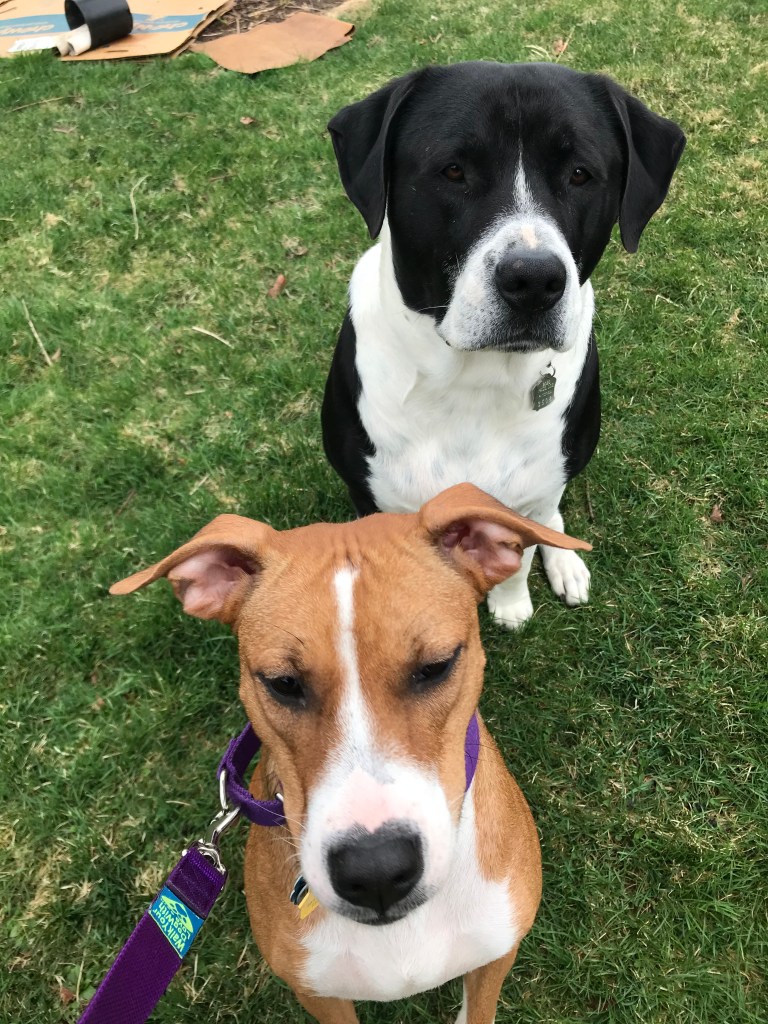
Octavia on her first full day in our home, learning “Sit”. Her mentor, Gogo, gives support. And waits for a treat.
I live in the northeastern US, in a hilly area where winters tend to be snowy, and temps can dip below 0 degrees Fahrenheit, especially in January and February. Time was, up here one only needed to give heartworm preventive in Spring-through-Fall. But now, as climate varies, and can gift us with a 70-degree day on Christmas Eve (as happened in 2016), the appearance of mosquitos can happen ANY time. And besides, if one wants to travel with one’s dog to the South, where mosquitos have no “off” season, it makes sense to protect from mosquito-borne diseases year-round.
Just to review my background: not only am I not an expert on heartworm, I’m not an expert on dogs. I was drawn into foster due to my willingness, not my expertise. And for Octavia’s case, the group wanted someone who was home more than a few waking hours per day (me: check). And ideally, someone who had a confident, calm dog who could be a good role model (me and Gogo: double-check). And for bonus points, someone with a fenced yard so the new dog can safely explore without running off (me: score!).
Gogo was fostered when he was little. Gogo is great. Therefore, I foster. Whether it was a good move for me, psychologically, to take in a new untrained dog before I had even had a chance to clean the stealth-poops left by the puppies under the guest bed, despite all the duct-taped and wood-screwed barricades I had built, is another topic. And maybe a good place to start a therapy session….but I digress.
Octavia’s good qualities:
She knows to do her business outdoors.
She is highly food-motivated. This makes her much easier to train using treats.
She is very eager to please her humans. This makes it much easier to teach and reinforce new behaviors, by either heaping attention on her, or withdrawing it.
She does not bark. At all. I think she may be a hound breed that just doesn’t.
She is happy to sleep in her crate, all night.
Octavia’s challenging qualities:
She is insecure, and seeks attention constantly. Initially this meant she whined all day, unless she was asleep or being attended to. This is improving.
She does not know how to interact politely with other dogs. She moved quickly from being docile and shy, to approaching, pawing, jumping up on, and chewing on Gogo every chance she got. By day 3 of being with us, she was humping him to express dominance.
Fortunately, also around day 3, her post-surgical spay restrictions were lifted, so she was allowed to vent some of her energy by running in the yard. And at the same time, I let Gogo know he did not have to be so gentle, and did not have to put up with her shit. Gogo is more than twice Octavia’s size. They are coming to a new understanding.
She has minimal experience living in a house, and being polite with people. Her first impulse is to crowd, paw, lick, and generally be in a person’s face or whatever body part is accessible to her. It is well-intended, but gets old very fast when you’re the human at the receiving end.
Octavia has been here in my house for 9 days. So far, she has learned these commands:
Sit.
Come.
Lie down.
Sshh. Sshh. Sshh (be quiet).
OFF. (quit putting your front paws up on me/ furniture/ the dog/ the cat’s food shelf etc.)
Drink the water.
Eat the food.
And she has learned these life-affirming, don’t-wear-out-your-welcome concepts:
No-no. (works as shorthand for don’t chew that; quit whining; that’s not a toy; hey those are my good shoes; quit putting your paw on my leg, in my face, etc.)
Relax, or We relax now. (just learning)
Be peaceful, be gentle (when she is being too rough, or just too relentless, with Gogo, or me. She knows what this means, but inconsistently applies it.).
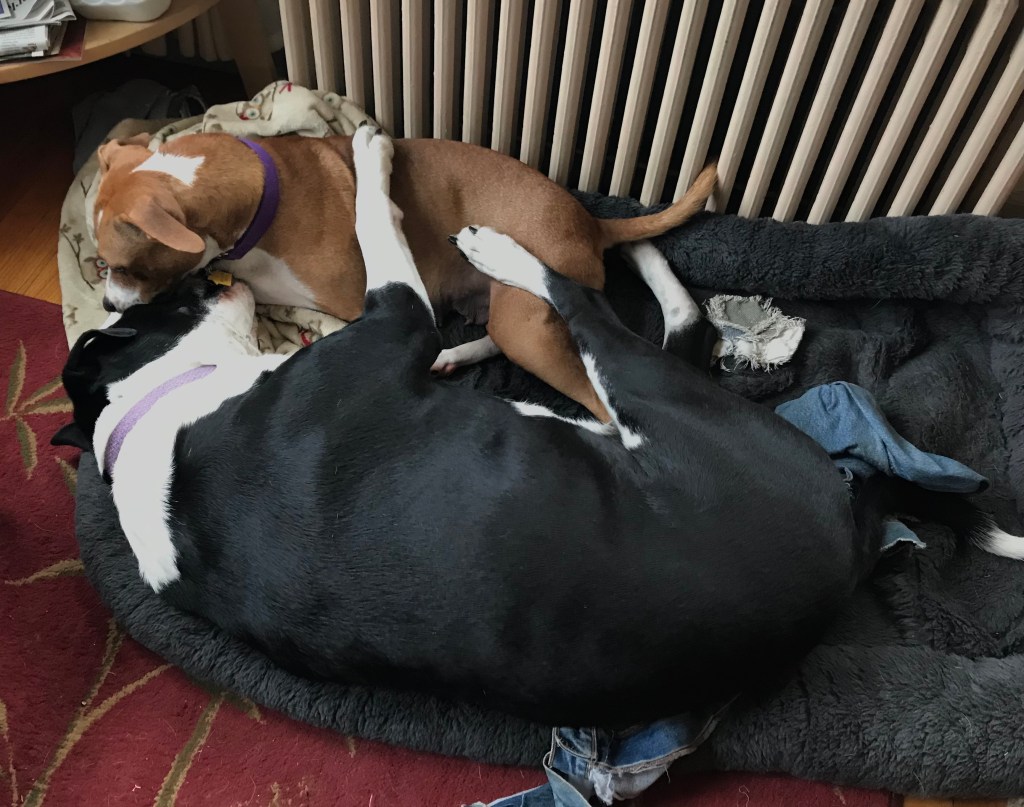
Early wrestling match. Gogo (Black & White) is still letting the new kid win.
Nine days in, our journey of fostering Octavia is just beginning. She still has to survive three more months of heartworm treatment, a couple of trips to the vet, and lots of training. By the time she is up for adoption, my plan is that she will be healthy, sleek, fast, and a pretty good dog. Let’s see if her goals align with mine.






 Puppies are Jerks