Breed Boom

Which of these is true?

a) Pit bull puppies can cost $2,000 to over $20,000.

b) Pit bull dogs are killed at a higher rate than any other dog breed in the US.

c) All of the above.

The answer is c). For many years, pit bulls have had a reputation as strong, fierce, loyal dogs. They have been popular as pets; then unpopular; then publicized as dangerous dog-fight dogs; then popular again.
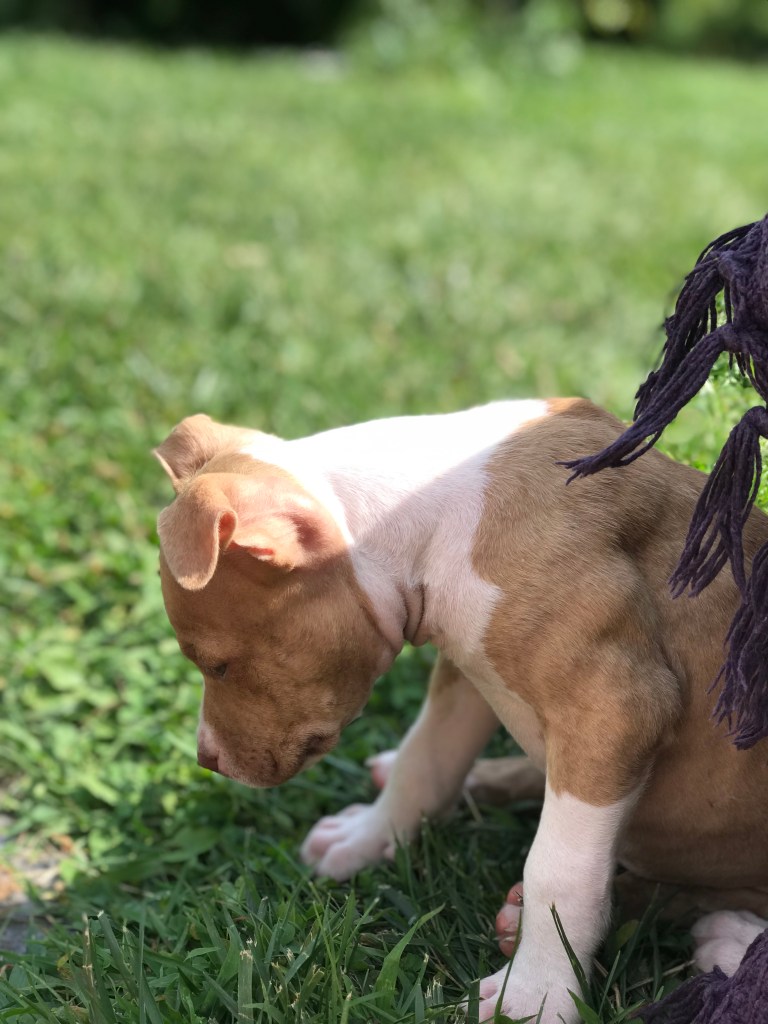
Deep in thought. Pit bull pup.

Periodically, the pit bull image has a setback. In the late 1980’s, Anheuser-Busch used a bull terrier they named Spuds MacKenzie to sell their light beer. They dressed him in cute shirts, surrounded him with tall, fawning human babes and called him the “ultimate party animal”.

The New York Times reported that between 1987 and 1988, ads featuring the dog helped increase light beer sales by 20%. When that ad line was discontinued, in 1989, it was rumored that it was because the dog was a pit bull, and pit bulls had lately come to be seen as mean and vicious. The official reason given by the company, according to Wikipedia, was that “the character’s image had started to overshadow the product.”

To many, pit bulls are a status symbol. Can anyone explain status symbols? I can’t, any more than I can tell you why anyone would want a Cabbage Patch doll (expensive ugly!), or a pair of Jimmy Choo stilettos (expensive pain!). Sometimes, when a thing is something you think you can’t have, you want it more. Sometimes, when you finally do get it, you want everyone to know you got it.

To some, having a pit bull by their side is a symbol of strength. If I can control this beast, I must be strong, right? For some, having a pit bull in the house is security against intruders. Sometimes the detail about teaching the dog the meaning of “intruder” escapes the buyer.

I recently watched an old episode of a trainer-solves-dog-problem TV show. The family had bought a pit bull puppy for their grandmother, who had no experience with dogs. A year later, the dog was barking at everything and everyone, and the family couldn’t have anyone over to the house without locking up the dog to prevent it from lunging at the visitor. So the trainer got to work, teaching the dog that not all non-family humans who visit are bad.

On camera, at least, no one sits the family down and says, “You got your grandmother a puppy, with no plans to train it?! WTF were you thinking?! And who sold you this dog?!” After intensive training, the TV trainer has gotten the dog to accept close family friends into the house without incident. Lawsuits, bloodshed averted in this case.

There are companies based in the US that have turned pit bull breeding into big business. If you’ve got the cash, you can have a super-sized pit bull flown to you, anywhere in the world. According to one dog-shipping company’s website, the dog or puppy can be brought right to your door, escorted by a trainer to get you started. Presumably, if you have tens of thousands of dollars to spend on a luxury dog, you can follow that up with a few thousand more to teach the dog that you are their family, among other skills.

In the metro Atlanta area, there is a dog kennel that breeds a few varieties of dog with “bull” in the name — including French bull dogs, and pit bulls. The niche this company has made for itself, to establish its brand, is that its pit bulls are bred to have short legs. Is there an advantage for a highly muscular and energetic dog to have short legs? Certainly not for the dog. How would it help a dog, to need to take twice as many steps to get anywhere? What is the advantage of building a locomotive body, and then putting it on tricycle wheels? Brand recognition, is the only answer I can come up with.

The sole purpose of this adaptation is to make the dog recognizable as a product of PitFall Kennels. PitFall Kennels is run by James Patton, brother of the musician who goes by the name Big Boi. Selling dogs with short legs is what sets their kennel apart. I did not do any sleuthing to find this out – I heard Big Boi himself describe his dogs, and how he got into the dog breeding business, while he was appearing on NPR’s radio news quiz show, “Wait, Wait…Don’t Tell Me!” It’s easy to find video clips of the brothers, and the kennel, on YouTube and elsewhere on the internet.

To its credit, there is information on line that PitFalls Kennels also does rescue work for dogs. Specifics on that aspect of the business are not as easy to find.

Evidence is everywhere that there are already far too many unwanted pit bulls in this country. Dog shelters post pleas for help on social media, often with specific expiration dates under dog photos. The “rescue by” date is the day on which the dog is scheduled to be euthanized.

A quick search on Petfinder.com today lists 3,100 available dogs (in shelters or foster homes) within a 100-mile radius of my zip code in Western Massachusetts. Of these, 475 are listed as pit bull terrier.

This well-dressed mystery mutt is part pit bull terrier.

Typically, if a dog is of mixed breed, such as Labrador retriever mixed with pit, pit bull terrier becomes the secondary breed listed in the dog’s description. Or ‘pit’ may not even be mentioned if unknown. Therefore, a search for “pit bull” does not yield listed mutts. So, while only 15% of these Petfinder-available dogs are listed as pit bull terrier, the percentage of pit-mix dogs is certain to be much higher.

Petfinder (http://Petfinder.com) is a leading resource for anyone looking for a pet to adopt. But some animals, due to poor health, or poor socialization, are not deemed to be adoptable, and don’t make it onto Petfinder’s site. Some animals don’t last a week in a crowded shelter, before they are euthanized, to make space for another animal that has better adoption potential. Many of the dogs euthanized, or put on death row, are pit bulls.

Training a puppy from scratch takes a ton of time and work. Training any dog that has been abused, trained to fight, starved or neglected takes time, patience and resources that sometimes are just not available. Even a dog that has been fed and taken to the vet, but not trained to be a good citizen, is a challenge. Every dog needs to be taught who the Good Guys are. If they are left to guess, they may end up defending against a hapless passer-by.

According to Save-a-Bull rescue (http://saveabullmn.org), studies estimate that up to one million pits are euthanized per year, or 2,800 per day.

Right now, status symbol dogs aside, the supply of pit bull-type dogs far exceeds demand. Conditions in the US do not support an increase in demand. Would it be too much to ask for a decrease in supply?


Pup v. Shrub: Who will win?

Don’t get a puppy in Winter.

A friend

With my eldest cat, Piccolo gone, after 21 epic cat-boss years, I sensed an opening for a dog. I started to mention it to some friends. “Do not,” one experienced friend advised, “get a puppy in winter. You don’t want to have to take them out in the freezing cold when they have to pee in the middle of the night.” That made sense to me. But “makes sense” and “want a puppy” don’t always match up.

So, you think you’re in charge?

I may have stacked the cards against myself by browsing on Petfinder in early Fall. There is an intro page, after you tell Petfinder your zip code, that says simply, “I want to adopt a :…” and you can click on “cat” or “dog”. Once you’ve made your choice, up pop the pictures. So what was I supposed to do – not look? Not click “dog”? Just because almost winter?

Many photos, applications and inquiries later, I adopted a 10-week-old mutt in early November, 2016. I read what I could about how to raise a healthy puppy, trying to stay just ahead of his destructive tendencies. For some reason, the how-tos don’t talk much about weather, as relates to your new buddy. Where I live, in Berkshire County, Massachusetts, we get weather. That fall and winter of 2016 were particularly snowy.

The wisdom on potty training: “Show your puppy where you want him to do his business outside, and praise him when he goes there.” And “Be consistent, so that he knows what you expect when you bring him to that area.” Under the “Teething” heading, there was “Your puppy will be looking for things to chew during his teething phase. Try to provide him with healthy chewing options to satisfy his cravings.” And also to save your shoes – that part, they leave out.

A couple of years earlier, I had planted a butterfly bush in my front yard. Each Spring, it grew new shoots from its base, which later flowered into beautiful, deep purple blooms that the butterflies loved to flit around. At its peak, the butterfly bush was over 6′ tall, and about 6′ across. A nice stopover for birds and insects, right in front of my dining area window. In winter, the old growth became dry sticks. Once young Gogo found out there was an abundant supply of sticks, anchored right there near our front steps, he was full of joy and purpose.

Lush summer greenery. All it needs is a little fertilizer!

That snowy season, the butterfly bush became the convenient place to pee, AND the place to harvest teething materials. Sometimes, I even harvested a stick from the bush, and brought it indoors for him. What the heck, I figured – it’s better than watching him try to taste all the furniture. And new branches will grow back in, in the Spring.

In the puppy’s first Winter, the rugs took a beating, the furniture did fine, I adapted to a disrupted sleep schedule, and the puppy thrived. By six months, he was almost fully potty trained. His teeth gleamed. Spring arrived on schedule. The butterfly bush…did not re-emerge. It remained a brown cluster of sticks. “Maybe…it’s just getting a late start,” I told myself.

I waited. I taught Gogo to pee other places. We kept harvesting sticks from the butterfly bush, though. Maybe that would wake it up? By summer, when everything else was green, I had to accept that we had killed the bush. It’s a hardy, non-native shrub in northeastern North America. Hardy, in normal conditions. But here’s a little detail you won’t find in Wikipedia: How much urine does it take to kill a butterfly bush? About one large puppy-winter’s worth.

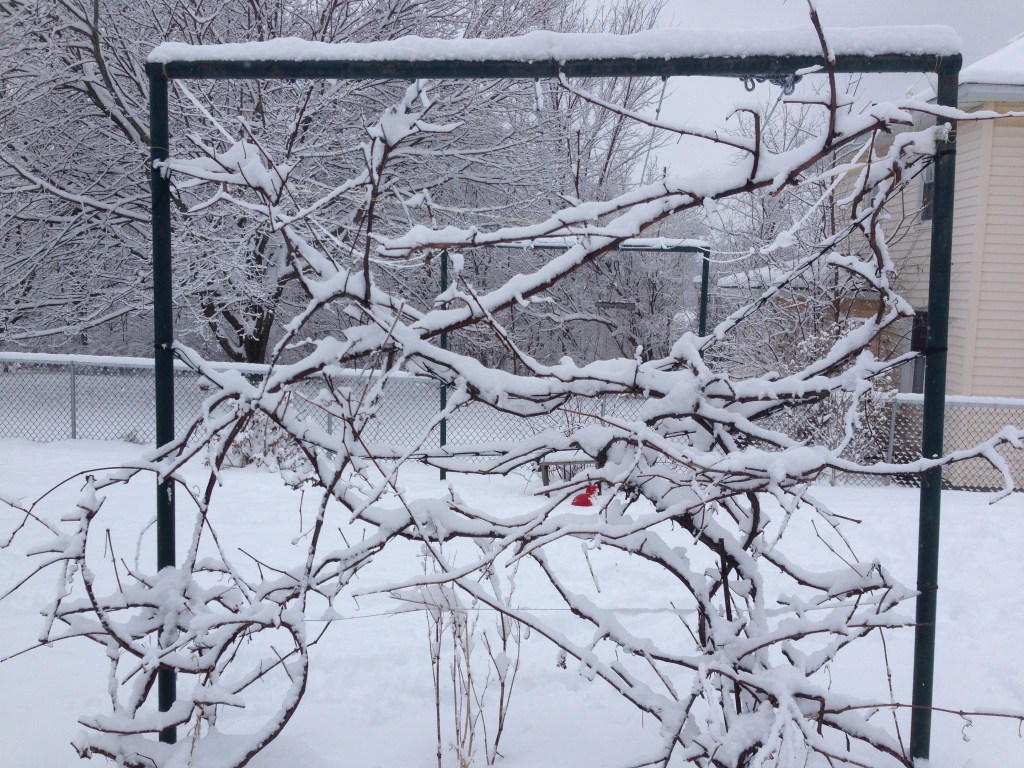
Winter garden scene in the Berkshires. Dormant grape vines.

Another fun fertilizer fact, for you lawn-and-garden fans out there: pee is full of nitrogen. In limited amounts, grass and other plants LOVE nitrogen. I’ve noticed this during summer months, when trying to put off mowing as long as possible. Most of the lawn stays at an even length after mowing. Then the dandelions, out of spite, will extend a full 2 inches taller than their surroundings, within a day or two. Normal.

Once a week goes by, though, it’s very noticeable that surrounding every Favored Pee Spot grows a ring of lush grass, an inch or three taller than everything around it. In the center of the Favored Pee Spot is a low, dead, brown bullseye. That’s what gives it away as a Favored Pee spot (by this time, Gogo is allowed to go out and pee on his own, so I don’t always witness where he goes).

My understanding, from experience and anecdotal stories from friends, is that girl dog pee is more damaging to lawns than boy dog pee. Boy dogs like to share their bounty, and mark as much territory as is caninely possible. So their ammonia-laden potion gets spread around. Girl dogs just squat ‘n’ go, not trying to prove anything other than how good it feels to have an empty bladder.

Around here, the grass is forgiving, the rain tends to be plentiful, and the lawn always rebounds — even the bullseyes. If I get to do it all over again with another puppy, male or female, I’ll teach the little critter to pee on my open-air compost pile, and really put that extra nitrogen to good use. They can pee on the shrubs, too. Just not always the same one.

The Waiting is the Hardest Part

When your critter’s at the vet’s office

I

called a friend on the phone yesterday, and to my surprise, she picked up very quickly. “Oh,” she said, “I thought you might be the vet’s office.” No one wants to miss a call from the vet.

How long do we wait? This charming young lady doesn’t mind waiting, as long as it’s with you.

Over the years, I have gotten used to waiting for an appointment with my vet. He is very thorough, and willing to explain problems and treatments clearly, and answer my oddball questions. An appointment with my dog’s doctor that’s scheduled for 1:00 pm has meant 1-ish, or maybe even 2-ish.

But my friend’s experience on this day was worse. She had dropped her two dogs off, without breakfast, early in the morning. And waited to hear. Then called, and was promised an Xray, and results, by the time lunch was over. She and I were speaking until almost 2:30, and she still hadn’t heard a peep.

She pictured her dogs hungry, and miserable. Meanwhile, she and her son had postponed their day’s projects, waiting to be able to pick up the dogs. What the fox terrier?? After some deliberation, she decided to go pick them up — Xray, or no Xray.

It’s not just us, and it’s not that we’re just getting older and less patient (Ok — with me, it is that). A very recent article by Julia Taliesin on Boston.com notes that vet office wait times are up everywhere, partly because so many people have added pets to their households, and partly because rookie pet parents aren’t sure what to do if there’s a cough, a scratch…or worse. So they call the vet. https://www.boston.com/?post_type=post&p=22754109

Now, other than recommend to all the teens and twenty-somethings we know that they go to veterinary school, what do we do? We need a short-term plan that keeps our pets healthy, and us sane.

My answer to this is: learn pet first aid. And get a pet first aid kit. These might sound excessive at first. Especially when you find out how expensive the first aid kit is. But this recommendation is not only for the over-prepared, risk-averse coddler of pets.

If you’re not sure what bloat looks like in a dog, or what to do about it, take the class. If you have a flop-eared dog who gets into mischief a lot, you can learn to bandage those ears in a class. Even if you know how to bandage humans – you’ll learn something (like: floppy ears should be pressed up on the head when you bandage them; prick ears should be pressed down, to manage bleeding).

Do you have what you need to clean and bandage your dog’s paw when he rips his toe pad open again? Are you sure? That’s what you get when you get a first aid kit — the feeling of being sure you can help, and won’t hurt your buddy. Even if you’re forgetful, or disorganized, or your overgrown mongrel is a big fat baby when he has to have his feet handled. In my house, all three conditions apply.

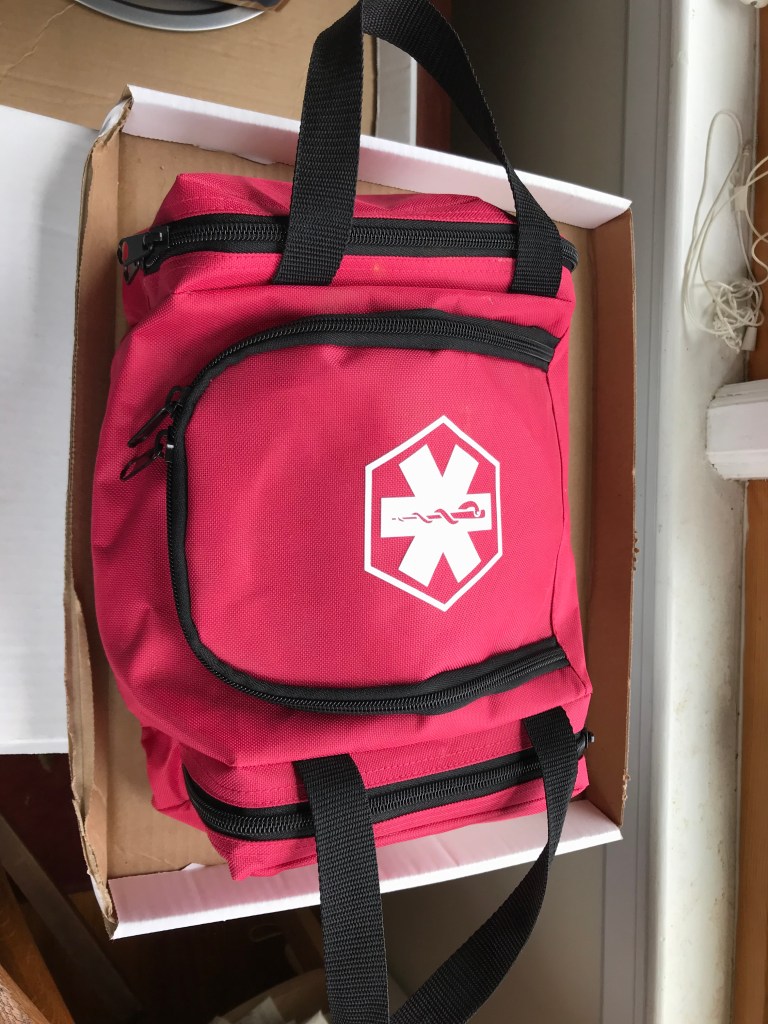
Pet first aid kit comes in a well-organized, way-cool zip canvas bag.

I haven’t done extensive market research on either pet First Aid/ CPR classes, or on first aid kits. I found a class, and took it. Then I researched my inner soul, to find out if I was going to get around to assembling all the recommended supplies that go into a good pet first aid kit. I wasn’t. So I ordered one from the nice people who ran the pet First Aid/ CPR class. You can find them at Fourfootedfamily.com.

The available classes from Four Footed Family are given in person, or in hybrid format, in central and eastern Massachusetts. There is also an all-virtual class done on Zoom, for those out of area. The virtual version is the one I took, and it was terrific. I’m sure the in-person version is even better. I haven’t verified whether they still offer the first aid kits, or if their time and energies have had to be focused elsewhere… in any case, you will get a complete list of must-have items for a kit. And then it’s between you and your soul.

In addition to bandages and salves, this kit has the day-to-day tools you need to keep everyone ship-shape. Like good nail clippers for dog and cat. So the pedi-pedi isn’t quite so awful-awful.

Preparation at home is not a substitute for a visit to the vet. But it can help you know, and convey, the difference between a get-me-to-the-front-of-the-line emergency, like belly bloat, and an “oops, give him Tums and wait for the farts to start” moment, when your pet needs extra care.

“You…want to clip my WHAT?!”

P.S. – Octavia, the charming 2-year-old hound mix featured at the top of this post, doesn’t mind getting her nails clipped; and, her nails are white or clear, making it super easy to see the target. She loves to have her teeth brushed; generally just likes to be with her people, no matter what or where. She will be up for adoption very soon! She is in the Albany NY/ western MA area. If interested in learning more, please contact the author.

Heartworm shall not defeat us

And power cords shall not get in the way

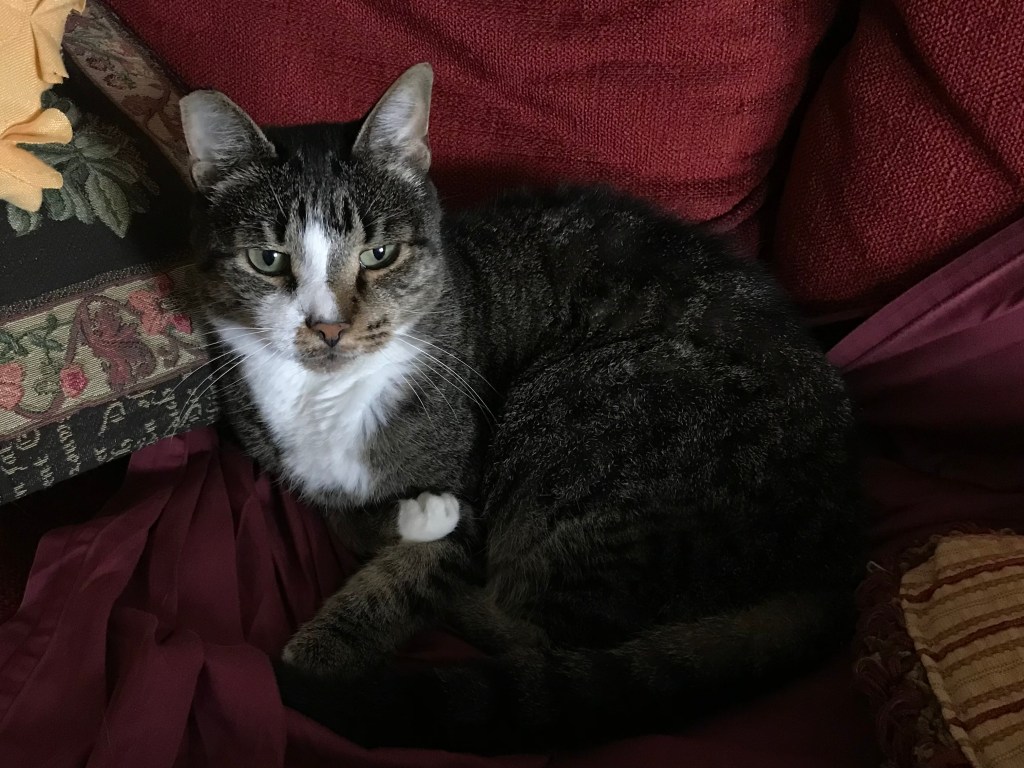
The healthy foster dog. Note the perky ears; the loving, confident eyes that say, “Sure, you can put your feet here. But I’m not moving.” See also, the lamp power cord under her tail….

This post was going to be all about how ‘Tavi is progressing during her heartworm treatment. About how she’s calmer, and more confident, and has learned to use the extra-large doggie door, even though she’s only a svelte 45 pounds. And, she seems like she feels…good.

Then this morning, she killed my lamp. Ok, maybe not killed – just mutilated and disabled it. Moved it from the “useful household furnishings” category to the dust-collecting projects heap, in a matter of — I don’t know — 30 seconds? Five minutes? Longer? If I’d known she was mutilating it, I would have stopped her. But I didn’t notice. And she was right there, at my feet, under the small table where I was typing. And she still feels good. But I feel bad.

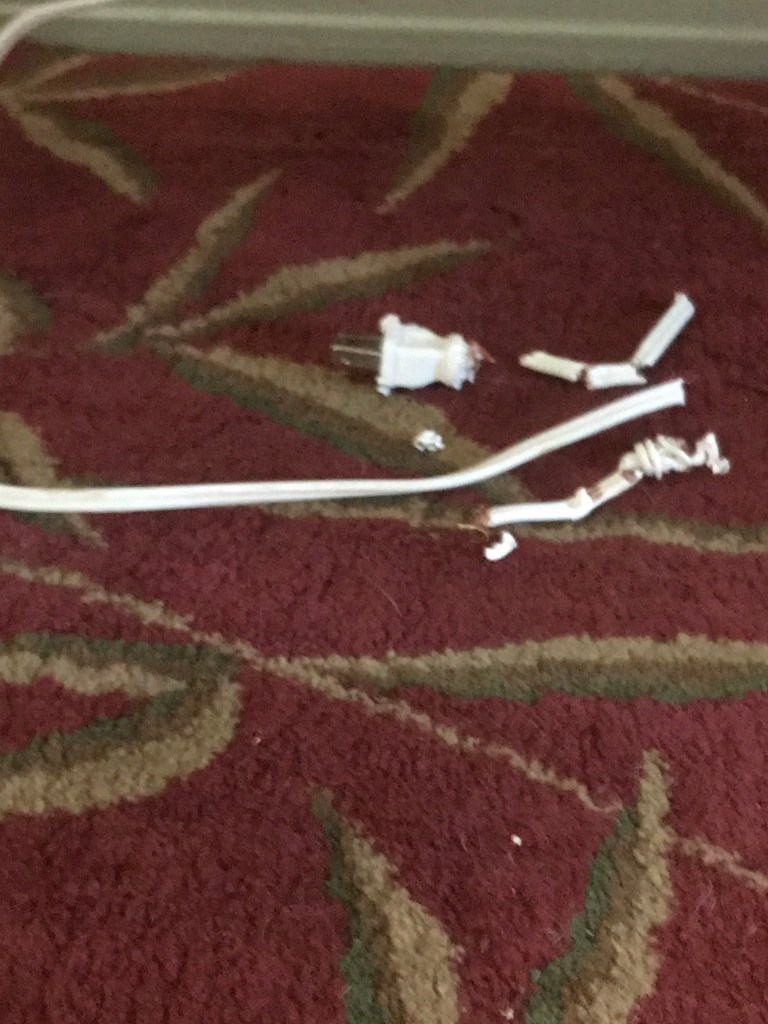
The evidence.

Should I have trained her not to chew electric cords sooner? Should I have moved the cord out of harm’s way? Was I supposed to crate her even though she loves to be with her pack — I mean right with her pack? Even though her whines, and her deep brown eyes, say ‘Nooooo! It’s not bed time!’ when I try to put her in?

I now think the answer to that last one was yes. Yes, unless I could work and respond to subtle ambient sounds at the same time. Which I can’t.

The victim.

While responding to emails this morning, should I have wondered why, after hours of restlessly poking around the house and tasting things, asking for ice cubes or a ball partner, ‘Tavi had been resting quietly at my feet for a solid half hour? I tried to stick to my policy, Ignore them, or you will never get anything done.

I could tell she was chewing on something. Fine. Chewing keeps her busy. Plenty of wholesome chewables ’round here. She wasn’t making teeth-on-bone sounds, though. Something softer. But not as soft as her (unstuffed) stuffy toy. And not squeaky, like a squeak ball. That’s good. Or…is it?? So I looked. And let the exclamations begin.

I saw a small scattering of off-white vinyl plus shiny copper, strewn on the floor where the dog had been lying, so happily, just moments before. The bent plug was disconnected from the lamp-formerly-known-as-the-Zoom-light on my work table (which is also known as my dining table). The dog scootched out of there as soon as the hollering began.

The perpetrator. The ears are down (‘guilty as charged.’) The eyes say “I’m really sorry…but did you know those things feel FANTASTIC in your mouth?”

Don’t worry — the lamp wasn’t plugged in. It was only used during Zoom calls, which are less frequent, these days, thank goodness. No electric shock to anyone. Just ‘I can’t believe I have a dog who chews electric cords’ shock, for me.

As I was saying, ‘Tavi seems to feel terrific. She’s been with me for almost 12 weeks. In two more weeks, she will get her final dose of heartworm medicine, and begin a period of more stringent movement restrictions. She’ll need to be in her crate more, like it or not.

Limiting her movement will keep her cardiovascular system quiet. Keeping her circulation calm will prevent the dying and dead pieces of heartworm from infiltrating her blood stream too fast, and causing an embolism. An embolism could kill her.

So, today’s lesson was a good one for me. I’d better toughen up.

The Cost of Dog Parenthood

Cheaper than sending a kid to college; but still — BE PREPARED.

Sure, usually it’s called dog ownership. But I am ready to admit that my dog fills a role that a dog twenty years ago would not have been invited to fill.

Twenty years ago, there were no Emotional Support Animals on planes, no Chewy.com, and probably no more than two different places you could go to get Fido a winter coat. Now it’s different. Dog family-hood in the early 21st Century is all I know. And I’ve made a spreadsheet about it.

I’m a dog mom, and I’ve got the Mother’s Day cards, coffee mugs and fridge magnets to prove it. Also, I have Gogo. He’s my dog, whose other title is The Sunlight in my Universe. When I picked him up from his foster home, all I had to plunk down was $275. Such a deal!

He was a mystery mutt, pretty-sure-he’s-a-pitbull-but-definitely-lab-boxer-plus-maybe-hound. I bought some food, a collar and leash, pee pads and a crate. His fur was kind of thin, so I thought he would need sweaters. That’s all I thought of, as expenses went.

If you’re thinking of getting a dog, but haven’t taken the plunge yet, this might be a good moment to take a hard look at the financials. If you already have a canine Sweet Baboo, this post may serve to confirm that you’re not alone, and you’re not imagining it: dogs get expensive.

The following cost estimates are based on my real bills, since 2016, and project forward from 2021 until 2033. In this scenario, this dog will live to be 17 years old. That’s optimistic for a large-breed dog, but not unusual for smaller breeds. Each family makes choices along the way: how expensive his food is; how many toys he gets; how often his bed is replaced. Each family will complete this adage its own way:

Shred it once, shame on you.
Shred it twice, that's coming out of your allowance.
Shred it three times...maybe we have to rethink the wisdom of buying you fluffy beds. Ok, ok. One more....

Some items are not optional, in my opinion, and were unknown to me before I got Gogo. For instance, in the past 5 years here in the Northeastern US, leptospirosis and Lyme disease have become so prevalent that many vets, including mine, recommend dogs get a vaccine for each, every year (Lyme vaccine and Lepto vaccine= $27 each this year).

Heartworm preventive medication, which used to be recommended mainly for Spring-Summer-Fall administration (prime mosquito time), is now generally recommended year-round, even here in the Northeast (Thanks a lot, global warming). For the vendor I use, that prevention comes to $112 each year. Without prevention, heartworm can be lethal. Even dogs under treatment for heartworm sometimes die from it. Not a risk I want to take.

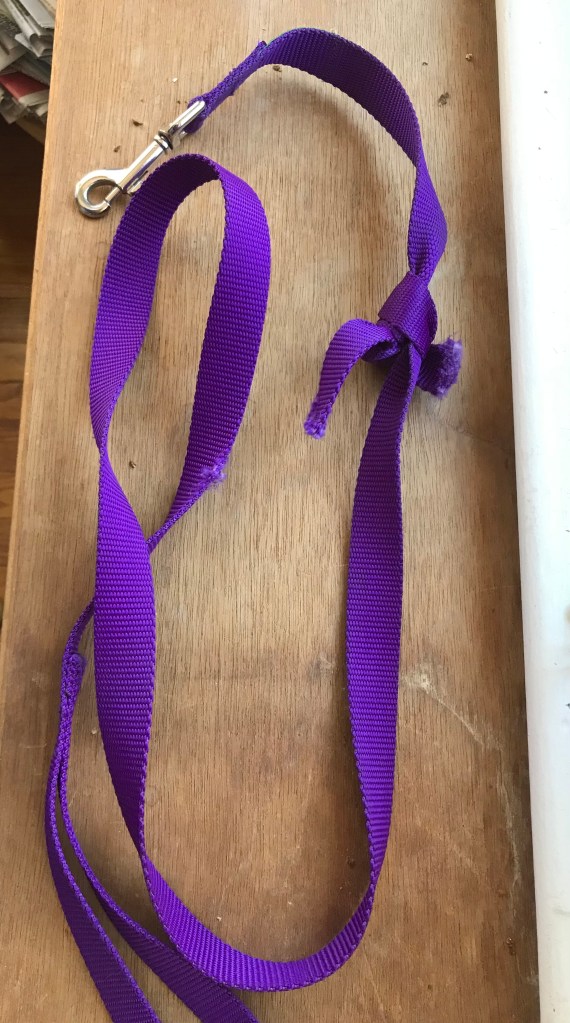
Your leash budget may depend in part on how good you are at tying square knots.

Here is the sum total of dog costs, starting with these assumptions:

Healthy, large-breed puppy

Low adoption fee

Private home setting with yard

No major injuries

YEAR 1YEAR 2 YEAR 3YEAR 4YEAR 17
ADOPTION FEE275
TOYS1001007560
FOOD & supplements900900900900900
poop bags4242424242
PUPPY SCHOOL200100
LEASH, HARNESSES, COLLARS145346234
winter coat6060
TRAINING COLLAR (ELECTRIC)110
ROUTINE VET CARE**292292292312
SURGERY, SPECIAL VET CARE314236180300 
Medicine (antibiotics,pain relief etc.) 7235506060
Flea & tick prevention268260260260260
Heartworm prevention112112112112112
Pet first aid kit180
Bed(s) and crate12016060
Human GOODS REPAIRS/REPLACEMENT8510075
Human CLOTHING REPLACEMENT200120
FENCED-IN YARD (4′ high)$7,000 
Housing premium*$1,400
vacation boarding (1 or 2 weeks/yr.)2803850150300
City dog license2525202020
Annual total       $3,176        $10,149         $3,584        $2,310     $1,994 
Lifetime total (lifespan = 17 yrs.)$48,052
Sample costs for a healthy dog

Purposely excluded here are the extras – like a fabric budget for making a fabulous bow tie collection, for example. Also, there is no allowance for major surgeries. A TPLO surgery (tendon repair, common for large and/or very active dogs) can cost thousands of dollars. You can consult gofundme.com for confirmation on that. Lots of owners saying “my dog needs this surgery…help!”

The extra-expensive years (so far) have been years two (splurged on a fence for the yard; gates on both sides) and three (fancy insulated doggie door purchase). These were, in large part, quality of life gifts to myself.

Take this as just one budgetary example, from a person who always, always wanted a dog, lives in a cold climate, and is highly risk-averse. Your results may vary.

Ticks: Can’t live with ’em, can’t kill ’em all

It’s true: They ARE worse than ever.

Goal 1: Keep ticks from climbing on you and your pets in the first place.

Goal 2: Get rid of any ticks you find hitching a ride, as soon as you see them.

I live in central Berkshire County, Massachusetts. Technically, I’m in a city. But the deer, groundhogs and bunnies all roam here, too. And that means there are ticks. The suddenly summer-like weather gets some credit, as well. This year, the ticks are EVERYWHERE.

I moved to the Berkshires so I could spend time outdoors. I like to dig in the dirt. I got a dog. Turns out, he likes to be outdoors, and dig in the dirt, too. But now, ticks. What are we supposed to do??

We love dirt. And fresh air.

I just read a letter to the editor in the local newspaper (shout out to The Berkshire Eagle) suggesting that we in the Berkshires should warn visitors to be wary of ticks, if they plan to go for a hike. I agree with that. But this year, it isn’t as if there are places one can go, where there are no ticks. How in the Woods are we supposed to find a safe balance between the parasites we fear, and the fresh air we love?

By the time studies come out to declare that yes, New England, you are more infested than ever, and Lyme disease has gone up with it, valuable defensive opportunities may have been lost. So, I’m acting on what I see. The enemy is here. War is now.

By nature, I am a peace-loving, creature-respecting person. When I find spiders hiding in the corners of my house, I capture them and escort them outdoors. If they are precariously close to being washed down the drain, I scoot them out of harm’s way. I’ll admit there have been plenty of times when a black jumping spider (they look to me like teeny tarantulas; but they jump, instead of crawling, when they need to be evasive) has startled me into jumping a little bit, too. But spiders do good stuff, like eat gnats and mosquitos and other bad actors.

There is nothing good about ticks, unless you are someone who eats them. Chickens, turkeys, opossums and guinea fowl thrive on them. I’ll assume you, reader, are not one of those.

A decade ago, I put tick prevention in the same category as first aid for snake bites: good to know, but I’m probably not going to need to apply it. Then, a few years ago, my indoor cat snuck out, and by the time he came home a few days later, he had a tick so engorged, it looked like a pale little balloon sticking up from his head.

Next I got a dog, and I learned to scan him every time we came in from the woods. Now it’s four years later, the Spring of 2021, and it’s ticksanity out there. We pick up ticks just by walking past unmown grass. In a rural-ish city. For two years I’ve been fostering puppies and dogs who aren’t able to be put on flea and tick prevention medicine right away. Now what?!

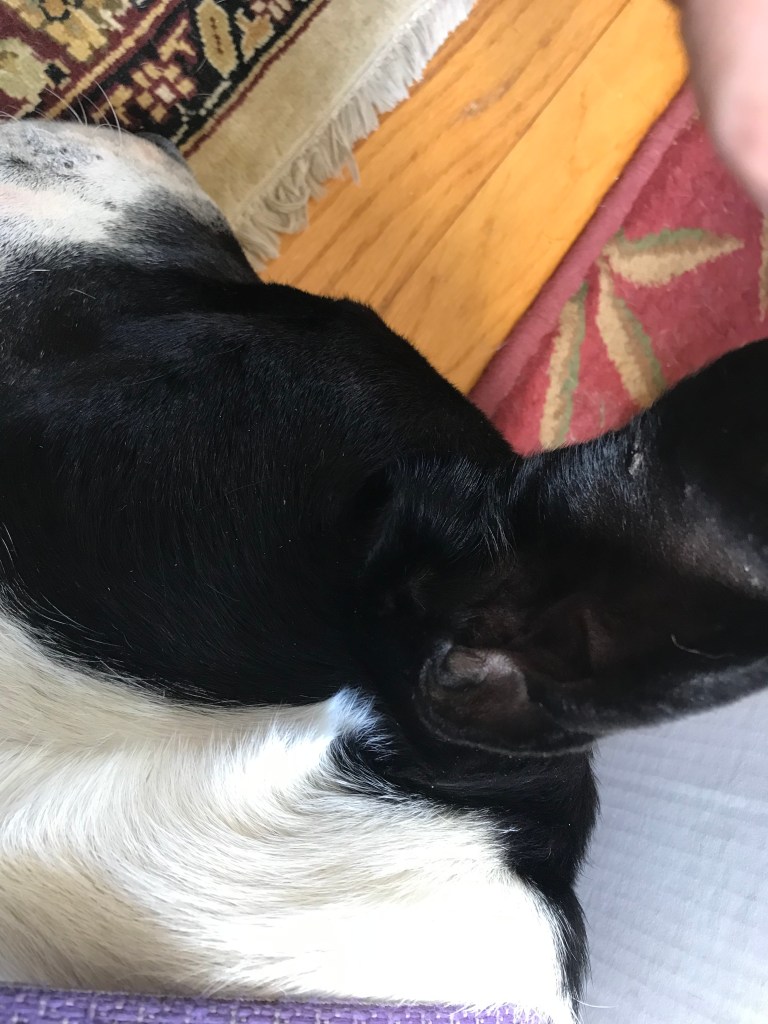
Ears, especially floppy ones, are vulnerable to ticks. Check the pockets!

I am writing this for dog owners, or even recreational walkers, who are already doing the basics: vet-recommended flea & tick treatment (for dogs and cats); bug repellent oil or spray for you and your best friend; avoid walking through tall grass; tuck pants into white socks (I’m…too sexy for these woods, too sexy for this path… too sexy to get Lyme diz- eeze…). Thorough skin check when you get home.

I fear Lyme disease more than I fear… most things. And I have found that available advice about ticks and what to do with them is incomplete, or confusing, or just plain hard to follow. Like: Use tweezers/ Never use tweezers! Get the tick off/ Don’t touch a tick with your hands! (wait — what??).

I will describe the approach I have been using to keep ticks from getting me and my pets sick. As my menagerie has expanded, ticks have proliferated, and the weather has gotten drier, I have gotten dead serious about winning this fight. You go climbing on my 7-week-old foster puppy who just figured out that pooping outdoors is a good thing, and I am coming after you, mother sucker.

Defense 1: be toxic

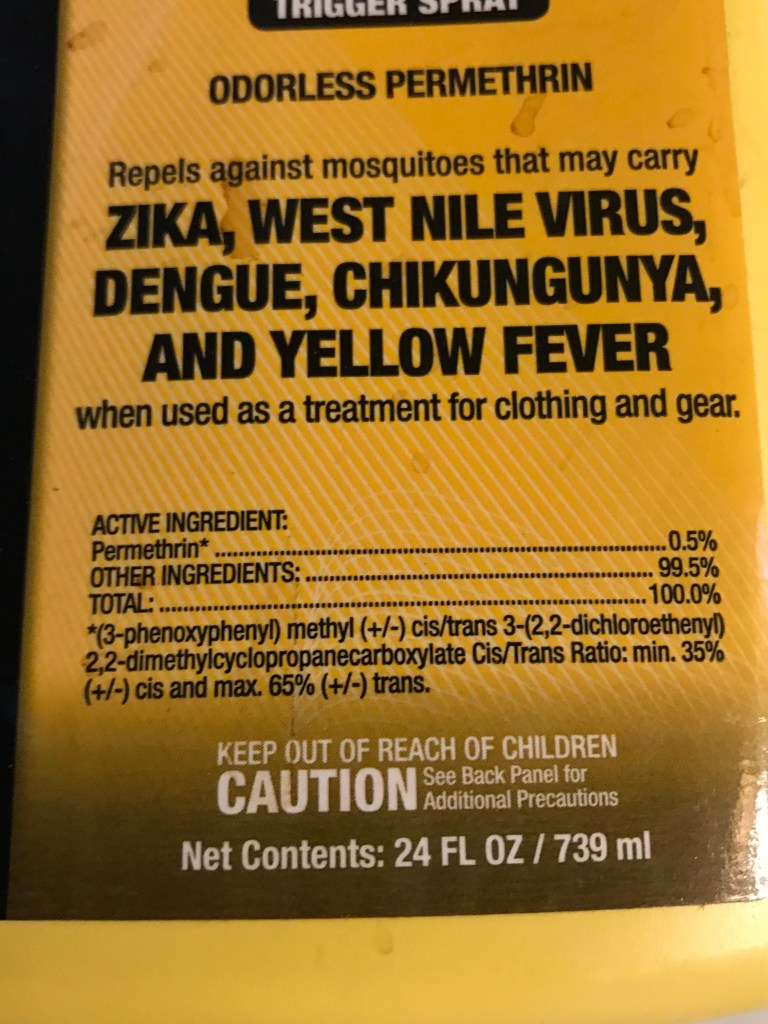
In life, I try to avoid excessive use of chemicals. But for tick prevention, I feel the little buggers have left me no choice. So I cautiously use a permethrin spray on my shoes, and on the dogs’ bedding, to kill any ticks that have the bad judgement to try to follow us home. Permethrin takes planning. It has to be sprayed on fabric — never on skin — and allowed to dry completely (out of direct sunlight, and away from animals) before you wear the item (or before dog or cat sleep on it).

I use a relatively dilute form of the spray (.5% permethrin), found in sporting goods stores in the section for hunters. The directions in and on the package are very clear and specific. Permethrin at any percentage is a neurotoxin for cats, if they are exposed to it wet. Not something to be messed with. Once dry, permethrin doesn’t have an odor, and is clear; so it behooves you to remember what you treated. Including, if it’s a blanket or towel for your pet to sleep on, which side you treated.

Ticks die relatively quickly when they come into contact with the permethrin. So this will catch any of those who didn’t die from the flea/ tick treatment you normally give your pet (ideally, those work once the tick has bitten and tried feeding on the animal). Maybe the tick was just strolling around on you or your dog, and was still scouting out a good place to bite, when your dog went to lie down on his permethrin-treated blanket. Bye-bye, tickypoo.

Permethrin spray bottle label. All precautions listed must be followed.

Defense 2: be stinky

Part of the way ticks find us is by our smell, in addition to our body heat and proximity. If we stink of oils they hate, they will avoid us, and wait for a better ride out of the grass. There are many choices for repellents that are safe for you and your dog. Please note, some products that are safe for you are not safe for your critters. The oil I use for my dog (and our fosters) is not safe for cats. It says so on the label. It includes essential oils of peppermint and rosemary, among others. This one is from a local company called Walk Your Dog With Love (walkyourdogwithlove.com), and I put it on the dogs’ collars before we go out in the neighborhood. Perhaps you’ve smelled us coming…. But it does help.

Offensive move 1: if you see it, grab it

Many times, ticks are visible on the surface of your pet (or on your clothing) before they have latched on well. They may be strolling along, looking for a juicy spot. Or they may be just settling in, amid fur, but not latched onto the skin yet. I use a take-no-prisoners approach. No waiting til we get home, no worries about touching a diseased pest. I just grab it with my fingers, hold it til I see a flat spot to drop it onto, find a stone (or use my shoe), and squish it.

If no flat spot is around, I may just try to flick it as far away from us as I can. I just don’t want it coming back. I was going to wash my hands as soon as we got home anyway, so…I’m less worried about touching disease briefly, than I am about letting a tick get settled in on my family. I’m sure this approach is not for everyone.

Offensive move 2: find, remove, murder

Once home from the walk, it’s time to do a real all-over check. It takes a few minutes, but in my experience, the dogs don’t mind one bit. From their perspective, it’s a great opportunity to get their ears fondled and their arms massaged. In my dog’s case, the trick is to get him to roll over for a tummy check, before he has relaxed all the way into REM sleep. He’s heavy.

The tools:

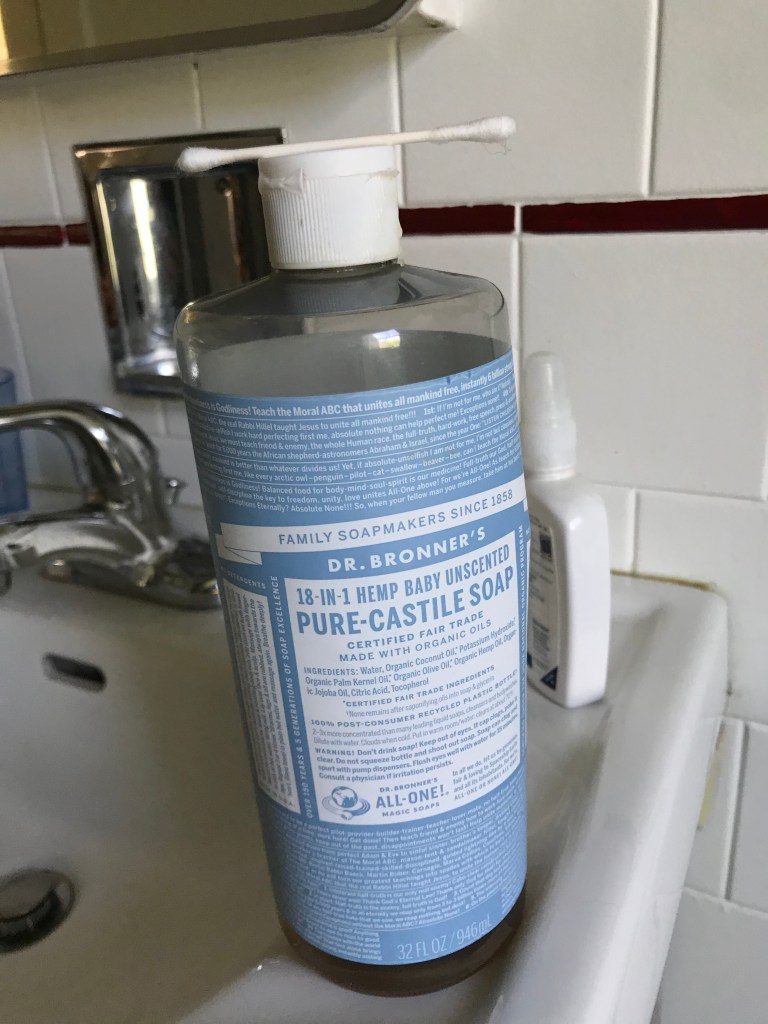
  • plain liquid soap
  • cotton swab
  • V-shaped tick removal tool (“tick key” or similar)
  • strong flashlight
  • rubbing alcohol
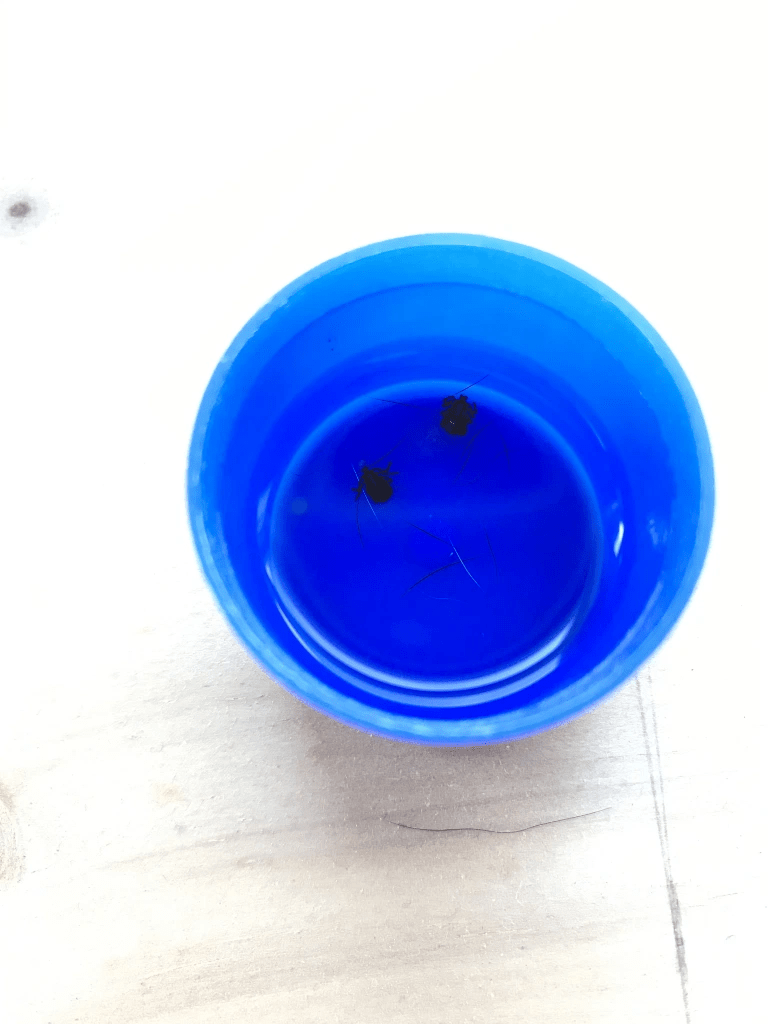
  • small plastic cup, such as the cap for a travel-size hairspray; fill with the alcohol
  • patient hands

V-shaped tick removal tool, and a strong flashlight to help find the ticks.
A Cup of Death – small cup of rubbing alcohol, to send ticks to their final swim

Use the flashlight and your hand to see and feel all over your dog’s coat to see any small, dark bumps. Ticks lie fairly flat, but they will feel noticeably different than your dog’s usual coat. The flashlight will illuminate the nooks and crannies, and let you see better where the fur may be dark.

ESPECIALLY CHECK:

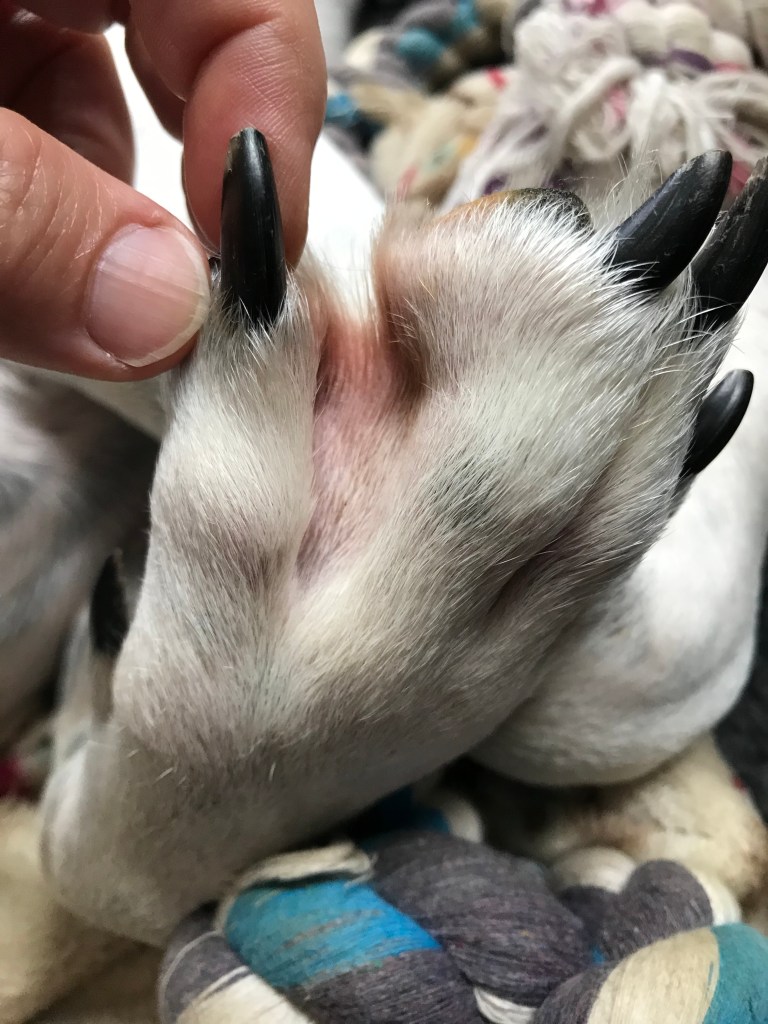
  • between all toes – top view AND bottom view (dog has to be lying down);
  • in and on ears, including the fairy pockets (the little pocket near base of ear);
  • lower legs/ feet;
  • face – likely to be the contact point when your dog sniffed the grass.
Gently splay your dog’s toes to find interlopers.

When I find a tick, I give it a little tug first to see if it’s loose. If it’s attached, it’s war. I do this:

Soap up the cotton swab, and apply soap directly to the little bugger. Sometimes just swirling the soap all around the tick is enough of an irritant to make the tick let go. If not, and I’ve been rubbing the soap on for a good minute, it’s time to use the V-shaped tool. I press the tool against the skin, and use the “V” to scoop the tick off, moving in a straight motion. Some say it’s best to just use the tool, and skip the soap. Those people are probably better at tick-scraping than I am. I like that the soap makes the tick let go, either a little or a lot, before I try to scrape it. The goal is to get the WHOLE tick.

Once the tick is free from skin, it’s time to dunk it in the waiting Cup of Death. I shove it right in there, making sure it sinks to the bottom of the isopropyl alcohol in the cup. The legs stop moving within a minute or two. But I usually wait a long time, before I dump the contents from the cup. Best to be sure.

Ticks love to hide under here.